
In the run-up to harvest, many fruit growers face the same problem: whilst fruit on the outer edges of the canopy is well coloured, fruit in the inner parts of the canopy or near lower branches tends to be paler, uneven in colour, and of poorer market quality.
This situation is common with apples, pears, peaches, cherries, grapes, citrus fruits and other fruits where appearance is a key requirement. In many cases, the orchard does not lack sunlight; the real issue is that sunlight does not reach every part of the canopy evenly.
The upper and outer branches of the canopy receive stronger light, whilst the fruit in the inner canopy and on lower branches remain in the shade for most of the day. If fruit does not receive sufficient effective light during the colouring period, the final colour will often be weak, and the proportion of fruit falling into lower market grades will increase.
This is why many fruit growers use fruit tree reflective sheeting prior to harvest.
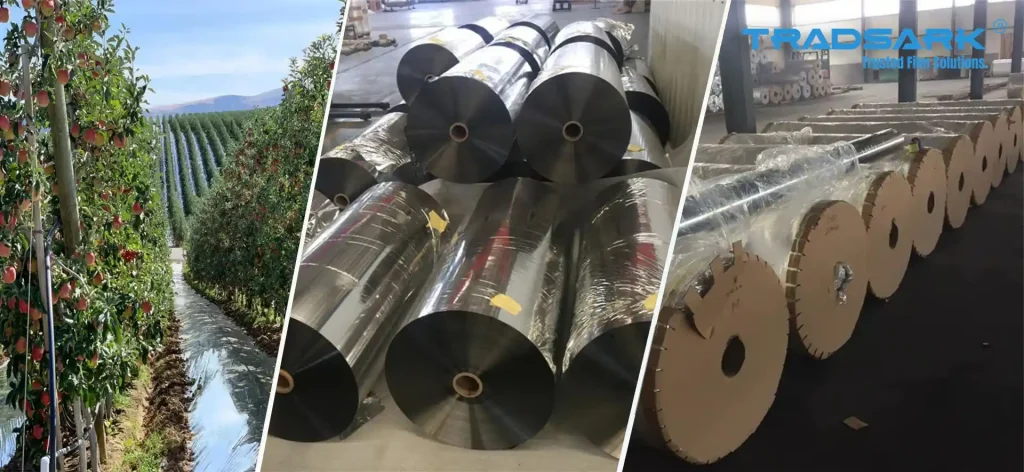
Reflective sheeting is typically laid on the ground in orchards, with the silver reflective side facing upwards. It reflects some of the sunlight that strikes the ground back into the canopy, helping fruit in the interior and lower layers of the canopy to receive more light during the colouring stage.
It cannot replace pruning, canopy management or appropriate harvesting times. However, if the orchard is well-managed and the reflective film is applied at the right time, it can serve as a simple, cost-effective supplementary tool to improve fruit appearance.
Why Fruit Color Is Often Uneven
Many fruit growers initially assume that fruit colouring depends primarily on the weather. They believe that as long as there is ample sunlight in the area, the fruit should colour well. However, in real orchards, the distribution of light is far more complex.
The canopy of a fruit tree is a layered structure. Leaves and branches block the light. While the outer parts of the canopy receive direct sunlight, the fruit within the canopy can only receive weaker, diffused light. This disparity is even more pronounced in high-density orchards, or those with vigorous trees or dense foliage.
Consequently, fruit growers often observe the following:
- Fruit on the outer edges colour earlier;
- Fruit in the inner canopy colour more slowly;
- Fruit on lower branches tend to be paler in colour;
- Harvest quality is inconsistent;
- More fruit is downgraded;
- Picking efficiency is compromised.
For fruit growers, this is not merely a technical issue, but one that directly impacts their income. Even if an orchard has a good yield, if too much of the fruit fails to achieve the desired colour grade, the final profit will still fall short of expectations.
Translated with DeepL.com (free version)uch fruit cannot reach the expected color grade, the final return will still be lower than expected.
How Reflective Film Works in the Orchard
The purpose of reflective film for fruit trees is to enable the orchard floor to contribute to light utilisation.
Without reflective material, most of the sunlight reaching the ground would be absorbed by the soil, grass, weeds or dark-coloured mulch. With a silver reflective surface, some of the light can be reflected back into the tree canopy.
This reflected light is particularly beneficial for fruit that would otherwise receive little direct sunlight, especially fruit in the lower and inner parts of the canopy.
In practice, reflective film may help to:
- Improve the distribution of light within the canopy;
- Promote more uniform fruit colouring;
- Improve the appearance of lower-level fruit;
- Make better use of natural light;
- Improve the consistency of fruit appearance prior to harvest;
- Under suitable orchard conditions, increase the likelihood of fruit achieving a higher commercial grade.
The final outcome depends on the variety, canopy density, orchard ground conditions, timing of installation, weather, film quality and overall orchard management. Reflective film cannot single-handedly resolve the issues of a poorly managed orchard. If the canopy is too dense, or if the reflective film is laid on a dirty, uneven surface, the effectiveness will be limited.
A more reasonable approach is to view reflective film as part of orchard management, rather than as the sole solution to all fruit quality issues.ilm as one part of orchard management, not as a single answer for every fruit-quality problem.
Why Aluminized Film Is Used for Fruit Trees
The surface of the film is crucial for fruit colouring.
Black mulch film can be used for weed control, moisture retention and soil temperature regulation, but it absorbs light and does not reflect much of it back into the canopy.
Aluminised reflective film serves a different purpose. Its silver metallised surface is designed to reflect light upwards. For fruit trees, where the aim is to improve fruit colouring and light distribution within the canopy, it is more suitable than standard ground cover film.
A good orchard reflective film should not merely appear bright when new; it must also be able to withstand real-world orchard conditions.
Orchardists and distributors should focus on checking the following:
- Whether the reflective surface remains bright during use;
- Whether the film tears easily;
- Whether it is easy to secure in windy orchards;
- Whether the reflective surface remains relatively clean and bright in damp, sunny and field conditions;
- Whether the roll width is suitable for orchard row spacing;
- Whether it is convenient to lay, retrieve and store;
- Whether the supplier can maintain consistent batch quality.
This is why Tradsark has developed aluminium-coated PE and PE/PET orchard reflective films. For real-world orchard use, strength, ease of handling during installation and consistent reflective performance are just as important as surface brightness.h, handling, and stable reflection matter as much as brightness.
When Reflective Film Makes Sense — and When It May Not
Reflective film is most suitable for orchards where the colour of the fruit affects its selling price. If lower-level fruit is frequently shaded, the grower is able to lay the film correctly before the colouring period, and the orchard floor can be kept relatively clean, then the benefits of reflective film will be more pronounced.
It is particularly suitable for:
- Apple orchards where red colouration affects grading;
- Pear, peach, cherry, grape and citrus orchards with specific appearance requirements;
- Dense or semi-dense orchards where lower-tier fruit is prone to shading;
- High-value orchards targeting the fresh fruit market;
- Orchards where pruning and canopy management have already been carried out;
- Growers seeking a simple supplementary tool to use prior to harvest.
However, it is not essential for every orchard.
If the canopy is very open and the fruit already receives sufficient light, the potential benefits of reflective film may be limited. In low-value orchards, where fruit colour has little impact on selling price, the necessity for reflective film is also reduced. If the orchard floor is muddy, weedy or difficult to clear, it may be hard to keep the reflective film clean, which will reduce its effectiveness. If the canopy is too dense and light cannot penetrate the tree structure, the light reflected from the ground will also be blocked.
In other words, reflective film should be used in orchards where there are genuine issues with light distribution; it should not be treated as a universal solution for all fruit quality problems.ssue.
When to Lay Reflective Film
The timing of installation is crucial.
For many fruits, reflective film is most effective when used during the main colouring stage prior to harvest. If laid too early, the reflective surface may accumulate dust, soil, fallen leaves or other debris before it is truly needed, or it may be prematurely damaged by wind and field wear.
If laid too late, the reflective light may not have sufficient time to influence fruit colouring.
In many orchards, growers lay reflective film shortly before the main colouring period. The exact timing depends on the crop type, variety, weather and local experience. For apples, pears, peaches and cherries, this is usually close to the pre-harvest colouring period. For grapes or citrus, the decision should be based on the stage when fruit appearance and uniformity of ripening become important.
A simple field rule of thumb is:
Reflective film should be laid early enough to aid fruit colouring; however, it should not be laid so early that the reflective surface becomes dirty or dulled before the critical period.
How to Install It Properly
Using reflective film is not complicated, but the quality of the installation will significantly affect its effectiveness.
Before laying the film, the orchard floor should be cleared as thoroughly as possible. Sharp branches, stones, heavy weeds and large pieces of debris should all be removed wherever possible. These items may puncture the film and prevent it from lying flat.
The reflective side should face upwards. The film should be laid in a position where the reflected light can reach the target fruit area. Lay it as flat as possible, but do not pull it too tight. If pulled too tight, it is more likely to tear when exposed to wind or when people walk over it.
The edges must be securely fastened. In many orchards, wind is the primary concern. If not properly secured, the film may be lifted, creased, torn or displaced from its original position. In windy orchards, securing the edges is not a mere detail but one of the key factors determining whether the reflective film will remain in place until harvest time.
Growers may use soil pressure, clips, ground pegs or other fastening methods depending on local conditions.
During use, the reflective surface should be kept as clean as possible. Soil, dust, fallen leaves and fruit debris will all reduce the reflective effect. If the film becomes covered with dust, leaves or mud after being laid, the reflective effect will quickly diminish. For orchards where the film needs to remain in place for several weeks, regular checks and adjustments will help maintain its effectiveness.
Do Not Choose Only by Price
Many buyers initially ask what the lowest price is. This is understandable, but it is not the best way to choose an orchard reflective film.
Films that are too cheap can cause numerous problems in the field:
- They tear easily during installation;
- They crease severely;
- They are difficult to secure;
- Their brightness fades quickly;
- Their strength deteriorates too rapidly when exposed to the elements;
- They are difficult to reuse under normal conditions;
- Farmers will complain after just one season.
For distributors, this is a serious issue. Low-cost film may sell well initially, but if fruit growers are dissatisfied after use, securing repeat business becomes difficult.
A more realistic procurement criterion should be:
Price + Strength + Reflectivity + Ease of field application + Roll specifications + Supplier reliability.
For fruit growers, the question should not simply be, ‘How much does this roll cost?’
The more important question is: ‘Will this film remain effective during the period when I need it most?’most?”
PE or PE/PET: Which Structure Should Buyers Choose?
For many orchards, PE-based reflective film is a good field choice. It is flexible, easier to handle, and works For many orchards, PE-based reflective film is a suitable choice for field use. It is flexible, easy to handle and ideal for seasonal use. Orchardists looking to keep costs down are generally more inclined to opt for PE reflective film.
PE/PET composite reflective film, on the other hand, is suitable for buyers who require a stiffer, more robust film, or who wish to offer a higher-grade product to professional fruit growers.
No single structure is suitable for all orchards. The most appropriate choice depends on the crop type, operational methods, expected lifespan, local price levels and market positioning.
Buyers should consider:
- Crop type;
- Orchard row spacing;
- Local wind conditions;
- Expected duration of use;
- Budget;
- Methods of installation and recovery;
- Whether single-season use is desired, or whether reuse is intended under suitable conditions;
- Local market positioning.
Consequently, Tradsark can provide different thicknesses, widths, roll lengths and packaging options according to buyer requirements.
Suitable Crops and South American Markets
Reflective film for orchards is best suited to cultivation scenarios where the appearance of the fruit affects its price. It can be used for apples, pears, peaches, cherries, grapes, citrus fruits, berries and certain greenhouse crops.
For the South American market, promotion should be tailored to the specific crops and practical requirements of each country.
In Chile, reflective film is suitable for apples, cherries, grapes and other high-quality orchards where there are stringent requirements regarding colour and export quality.
In Peru, it can be promoted for use in vineyards, citrus orchards and high-value fruit farms.
In Brazil, it can be used in citrus orchards, fruit farms, nurseries and greenhouses. Portuguese product terms such as ‘filme refletivo metalizado agrícola’ or ‘filme aluminizado para pomares’ facilitate local communication.
In Argentina and Uruguay, the product can be positioned for use in apple, pear and grape orchards, as well as for improving orchard quality.
In Colombia and Ecuador, it is more appropriate to promote it as a reflective material for fruit farms and greenhouses, rather than solely as a film for apple orchards.
In Paraguay and Bolivia, buyers may be more price-sensitive; therefore, practical roll specifications, clear product descriptions and a stable supply are particularly important.
In Spanish-speaking markets, the following product descriptions can be used:
- reflective film for fruit trees
- agricultural aluminium-coated reflective film
- reflective film for fruit orchards
What Distributors Should Check Before Importing
FFor distributors of agricultural supplies, reflective film is not merely an agricultural input; it is a product that needs to be easy to explain, easy to stock, and capable of generating repeat business.
Before importing reflective film for orchards, distributors should check:
- Material structure;
- Film thickness;
- Roll width;
- Roll length;
- Quality of the reflective surface;
- Tear resistance;
- Performance in outdoor use;
- Packaging method;
- Minimum order quantity;
- Private label packaging options;
- Whether the supplier can maintain consistent quality across repeat orders.
A good film should not merely offer excellent reflectivity. It should also possess sufficient durability for field operations, be suitable for export packaging, and demonstrate consistent quality across different batches.
For distributors, this product is also relatively easy to explain to fruit growers, as they are already well aware of the issues at hand: shade-affected fruit, uneven colouring and a decline in harvest grades.
Why Tradsark
For importers and agricultural distributors, Tradsark offers aluminium-coated PE and PE/PET reflective film rolls suitable for field use, with customisation options available for thickness, width, roll length, labelling and packaging.
Our focus is on real-world orchard applications. The film must not only reflect light but also withstand the practical challenges of laying, securing, wind exposure, humidity, storage and consistent supply.
Tradsark offers:
- Aluminised orchard reflective film;
- Aluminised PE reflective film;
- PE/PET composite reflective film;
- Customised thickness;
- Customised width and roll length;
- OEM and private label packaging;
- Export-grade roll stock;
- Product presentation advice for the South American fruit market.
For buyers in Chile, Peru, Brazil, Argentina, Colombia, Ecuador, Uruguay, Paraguay and Bolivia, Tradsark supplies orchard reflective film to fruit farms, horticultural suppliers and agricultural distributors.
Field Notes for Growers
From the perspective of agricultural extension services, reflective film is effective because it provides a simple solution to a visible problem in an orchard.
It requires no machinery and does not alter the orchard system as a whole; it simply helps fruit growers make better use of the sunlight that is already present in the orchard.
However, the details are crucial.
Do not expect reflective film to replace pruning.
Do not lay film in orchards with very dense canopies and then expect perfect colouring.
Do not lay the film on dirty, uneven ground.
Do not lay it too early, allowing the reflective surface to darken before the colouring period.
Do not simply buy the cheapest film without considering its strength and field manageability.
If laid at the right time, with the orchard ground well prepared and the film of suitable quality, reflective film may improve fruit appearance and help more fruit achieve a better market grade.
Growers use it because the problem is visible, the method is simple, and the effects can be observed in the field during the colouring period.
FAQ
What is fruit tree reflective film?
Fruit tree reflective film is a silver, aluminium-coated agricultural film that is laid on the ground in orchards to reflect sunlight back onto the tree canopy. It is primarily used to improve the distribution of light around lower-level and inner-crown fruit.
Is reflective film the same as black mulch film?
No, it is not. Black mulch film is mainly used for weed control, regulating soil temperature and retaining moisture. Reflective film is primarily used to reflect light back into the tree canopy, aiding fruit colouring.
Which crops can benefit from orchard reflective film?
Apples, pears, peaches, cherries, grapes, citrus fruits, berries and certain greenhouse crops can all benefit. Actual results depend on crop type, canopy structure, timing of installation and field conditions.
When should fruit growers lay reflective film?
It is usually laid before the main fruit colouring period. The specific timing depends on the crop type, variety, climate and orchard management practices.
Can reflective film improve fruit colouring?
Under suitable orchard conditions, reflective film may improve light distribution and aid fruit colouring. The effect is influenced by variety, canopy density, weather, nutrition, pruning and the timing of installation.
Can reflective film be reused?
Whether it can be reused depends on the film’s structure, thickness, field conditions, usage, recovery methods and storage conditions. Stronger composite films may be reused under suitable conditions, but this must be assessed on a case-by-case basis.
What should distributors check before importing orchard reflective film?
Distributors should check the material structure, thickness, roll width, roll length, quality of the reflective surface, tear resistance, packaging, minimum order quantity, and whether the supplier can maintain consistent quality across repeat orders.
Can Tradsark customise reflective film?
Yes. Tradsark can provide importers and agricultural distributors with custom thicknesses, widths, roll lengths, OEM labels and private-label packaging.
What This Means for Growers and Distributors
Reflective film for fruit trees is a material used in orchards to help fruit growers improve light distribution prior to harvest. In many orchards, the problem is not a lack of sunlight, but rather the uneven distribution of light within the tree canopy.
Aluminium-coated reflective film can reflect some of the light from the ground back into the canopy. When used correctly, it can improve fruit colouring, result in a more uniform appearance, and help more fruit meet market standards.
For fruit growers, this is a simple tool whose effectiveness can be assessed directly in the field. For distributors, it is also easy to explain, as growers already understand the issues at hand: shaded fruit, uneven colouring and a decline in harvest grades.
Growers use reflective film not because it sounds particularly advanced, but because the problems in the orchard are so obvious. A good aluminium-coated reflective film can redirect more light back into the canopy during the brief period when the fruit needs colouring the most.
For the South American fruit market, Tradsark supplies aluminium-coated orchard reflective film in practical specifications, with customisation options and export packaging.
If distributors or fruit supply companies require customised orchard reflective film, Tradsark can provide roll specifications, OEM packaging and product support tailored to local market demands.
