
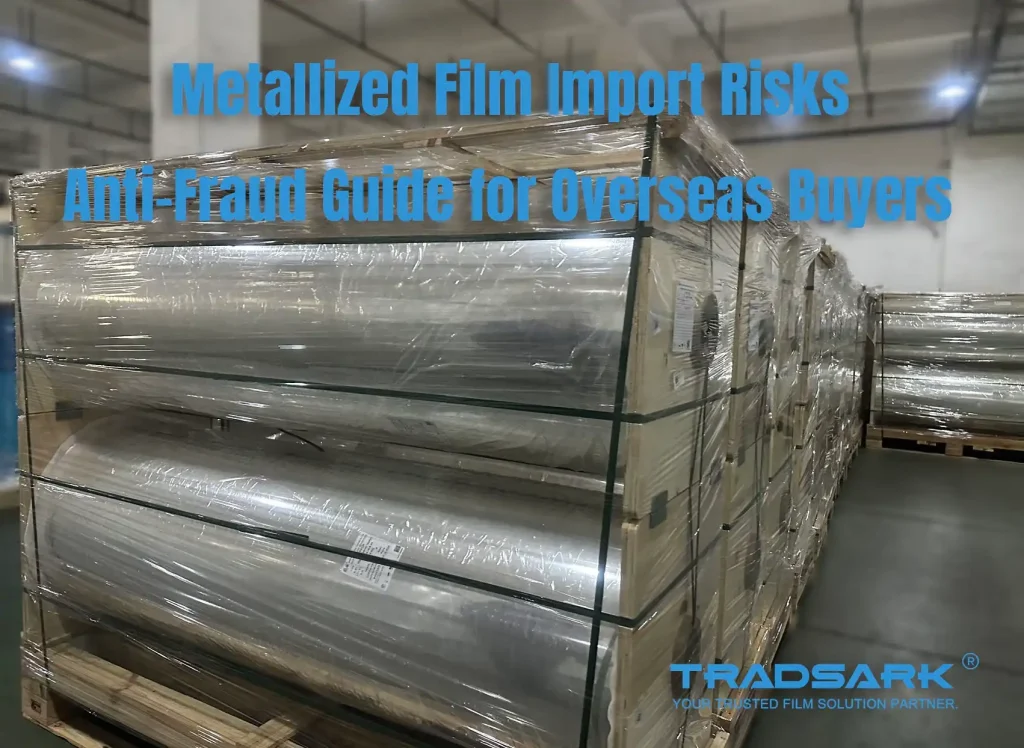
For overseas buyers, purchasing metallized BOPP, PET and CPP films is not just a technical purchase decision. This is also a risk control process. The main risks include wrong material selection, poor barrier performance, forged documents, false declaration of origin, tariff evasion and supplier identity. The following cases are based on public official information, some of which involve aluminum foil rather than metallized plastic film, but they are still closely related to buyers of metallized film, aluminum based flexible packaging materials and reflective packaging or insulating film, because they show the real customs, origin and compliance risks in this supply chain.
Case 1: Spain — False UAE Origin for Chinese Aluminium Foil to Avoid EU Anti-Dumping Duties
In December 2024, the Spanish tax authority reported that it had dissolved a criminal organization, which was accused of defrauding nearly 3.5 million euros of anti-dumping duties. According to the official statement, the aluminum foil roll is made in China, transported to the United Arab Emirates, and then transported to Spain with the modified document, which states that the origin of the United Arab Emirates is not China. The investigation was conducted in Valencia with the support of Europol and followed the procedures of the European prosecutor’s office; Five people were arrested and four others were under investigation.
For buyers, the lesson is clear: the origin document is not a small document problem. If the supplier provides a very low landed cost by changing the origin document through a third country, the importer may face customs investigation, seizure of goods, back payment of duties, fines and long-term compliance damage.
Buyer danger signal:
The supplier provides “UAE country of origin”, “turkey country of origin” or other third country countries of origin, but there is no real manufacturing certificate. The transportation route includes third countries, but the real processing process is not recorded. The certificate of origin, bill of lading, invoice and packing list do not match. The supplier said that this structure is mainly to “avoid the imposition of anti-dumping duties”. The supplier refused to provide production evidence or factory information.
How to avoid it:
The buyer shall verify the true production location, HS code, country of origin, production documents and anti-dumping tax risk before shipment. For EU buyers, they should verify the compliance of origin with customs brokers before placing large orders.
Case 2: Germany — EPPO Aluminium Foil Anti-Dumping Duty Evasion Case
In July 2024, the European prosecutor’s office in Cologne filed a lawsuit against two Chinese citizens, accusing them of allegedly evading the anti-dumping duties imposed on 20 kinds of aluminum foil imported into Germany. EPPO said that it was alleged that it had declared a false tariff number or a false country of origin Myanmar rather than China in order to evade tariffs, resulting in a loss of 474,903.94 euros. It also said that the German customer submitted an incorrect customs declaration after being informed that the metal foil was produced outside China, resulting in a further loss of 156,133 euros.
In March, 2026, EPPO reported the conviction of the same incident. One defendant was sentenced to one year and eight months’ imprisonment, suspended, and fined 100,000 euros. EPPO said that a German company operated by the defendant imported aluminum foil products and falsely claimed that the country of origin was Myanmar rather than China, avoiding anti-dumping duties of about 610,000 euros; It also pointed out that the German customer had unwittingly submitted the wrong customs declaration, resulting in an additional loss of about 140,000 euros.
This case is important because it shows that even if buyers rely on information provided by suppliers, they may be exposed. If the supplier provides false origin or customs information, the buyer may still face customs consequences.
Buyer danger signal:
The Supplier proposes to use different HS codes to reduce import duties. Country of origin changes between quotations, invoices, and shipping documents. The supplier cannot clearly explain whether the product is aluminum foil, metallized plastic film, composite film or other customs categories. The customs “solution” provided by the supplier is not supported by real production documents. The buyer is required to accept documents that do not describe the real product.
How to avoid it:
The buyer should not rely solely on the HS code or the declaration of origin recommended by the supplier. Before shipment, confirm HS code, product description, country of origin and anti-dumping tax risk with customs broker. This is particularly important for aluminum foil, metallized materials, barrier packaging structures and similar flexible packaging materials imported from the European Union.
Case 3: EU — Anti-Circumvention Action on Chinese Aluminium Foil Exported Through Thailand
In September 2021, the European Commission announced that it had expanded the anti-dumping duties imposed on household aluminum foil from China to imports from Thailand after an investigation found evasion behavior. The European Commission stated that Chinese aluminum foil manufacturers exported some products subject to EU anti-dumping duties to Thailand, and Thailand conducted small-scale assembly operations before exporting the final products to the EU. The tariff has been expanded to include imports from Thailand and retroactively levied. This case is not about the quality of fake movies. Third country handling and risk mitigation measures. For overseas buyers, the lesson is that if genuine origin or substantial transformation cannot be supported, products shipped from third countries cannot automatically be exempt from anti-dumping duties.
Buyer’s danger signal:
The supplier claims to originate from a third country, but the main materials or critical inputs come from China.
Only a small amount of processing is carried out in third countries. The supplier cannot explain what process changed the source of the product. There are no production records, processing invoices, or factory evidence from the claimed country of origin.
The land price looks very attractive, mainly because it avoids tariffs.
How to avoid:
The buyer should inquire whether the country of origin of the claim is based on actual production or solely on transit/minor processing. For EU buyers, anti circumvention rules can still apply even if the goods are exported from another country.
Case 4: United States — Circumvention Finding on Chinese-Origin Aluminium Foil Completed in Korea and Thailand
In November 2023, the US Department of Commerce issued a final affirmative avoidance ruling for certain aluminum foils exported from South Korea and Thailand using Chinese made aluminum foil and/or sheets. The Federal Register announced that these imported products were found to have evaded US anti-dumping and countervailing tariffs on Chinese aluminum foil. The notice also explains that importers and exporters must maintain certification and proof documents where applicable. This case is important for overseas buyers as it demonstrates that origin and processing routes not only affect the EU’s tariff exposure, but also the US’s tariff exposure. If the product is assembled or completed using inputs originating from China in a third country, customs authorities may still consider it within the scope of existing tariff orders.
Buyer’s danger signal:
The supplier claims that South Korea, Thailand, the United Arab Emirates, Türkiye or other countries are the countries of origin, and imports from China. Suppliers cannot provide proof of origin documents. The importer does not have exporter certification or production records. The product classification and material description are unclear. The supplier refuses to cooperate with customs document requirements.
How to avoid:
The buyer shall keep the importer’s certificate, exporter’s certificate, production records, invoices, packing lists, bills of lading, and product specifications consistent. If the product may be subject to anti-dumping/CVD duties, the buyer should consult the customs broker before shipment.
Material quality risk: counterfeit or lower than specified metalized film
Publicly verified customs cases are easier to record than private quality disputes. However, in actual procurement, material substitution is also one of the most common risks. Buyers may receive thin films that look like metal but do not meet the required structure, barrier properties, reflectivity, or food contact requirements.
Examples of quality risks include:
Silver ink printing film, sold as vacuum metalized reflective film; Low optical density metalized films are sold as high barrier films; Recycling or selling low-grade PET as food grade packaging film; Thin aluminum layer, poor oxidation resistance; Aluminum has weak adhesion and delamination after lamination; The sample quality is superior to the bulk quality; Food contact documents that do not match the actual film structure. These issues may not always arise in open court cases, but they are real buyer risks. The buyer should control through technical verification before bulk ordering.
How to avoid material quality traps:
Require a complete structure, such as PET/metalization layer/coating/PE or CPP sealing layer. Request OTR, WVTR, optical density, aluminum adhesion COF、 Surface tension and heat sealing data (if relevant). If the film is used for underfloor heating, insulation, or agricultural reflective film, test the reflectivity. Request to provide batch inspection reports, not just general data sheets. Validate food contact documents based on actual structure and target market. Run sample rolls on the buyer’s own printing, laminating, slitting, sealing, or bag making equipment. For large orders, arrange third-party inspection before shipment.
Buyer Anti-Fraud Checklist for Metallized Film Imports
| Risk Area | What Buyers Should Verify |
|---|---|
| Material authenticity | Is it real vacuum-metallized film, coated film, or only silver ink printing? |
| Base film | BOPP, PET, CPP, PE, recycled PET, or laminated structure? |
| Barrier performance | OTR, WVTR, test method, temperature, humidity, and sample structure |
| Metallization quality | Optical density, sheet resistance, aluminium adhesion, pinhole control |
| Food-contact use | FDA/EU documents based on actual structure and contact layer |
| Supplier identity | Real manufacturer, trading company, or unknown middleman? |
| Origin compliance | Real country of origin, production records, anti-dumping exposure |
| HS code | Correct customs classification checked before shipment |
| Sample-to-bulk consistency | Approved sample, retained sample, batch report, same production route |
| Shipment control | Pre-shipment inspection, roll labels, packing list, loading photos |
| Payment risk | Avoid full payment to unverified suppliers without inspection |
Tradark’s procurement suggestions
For metalized BOPP, PET, and CPP films, if false sources are hidden, barrier properties are weak, false documents, poor metalization, or supplier fraud occur, the lowest price may become the most expensive choice. Reliable Chinese metalized film suppliers should be willing to provide clear film structures, technical data, sample rolls, batch inspection reports, compliance documents (if applicable), and consistent commercial documents. Buyers should view procurement as a validation process, not just a price comparison.
The safest way to purchase is:
1) Confirm the final application;
2) Determine the correct film structure;
3) Verify the manufacturer and production capacity;
4) Require measurable technical data to be provided;
5) Test sample roll;
6) Check food contact information and customs documents;
7) Arrange inspection for large orders;
8) Confirm HS code and origin before shipment.
This process helps overseas buyers avoid quality loss, customs penalties, shipping fraud, and long-term supplier issues.
