
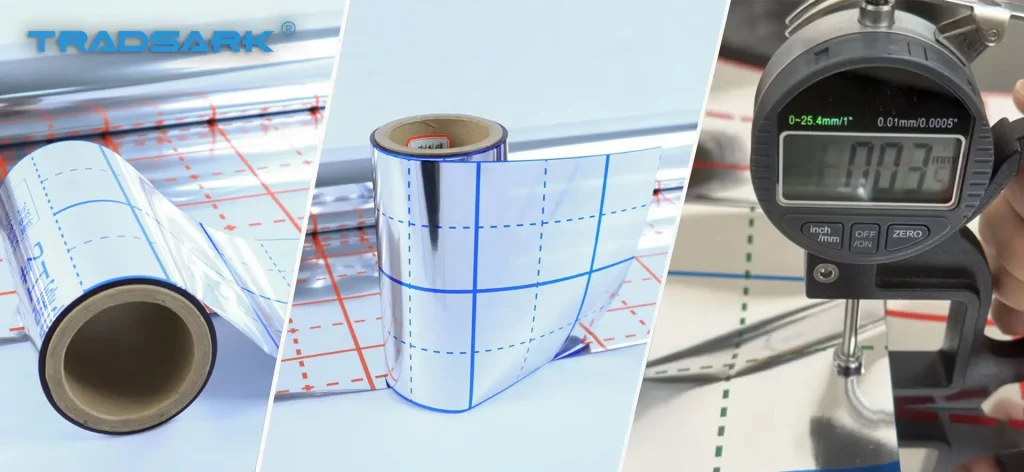
If you work in underfloor heating, HVAC accessories, building materials, or private label sourcing, you have probably noticed something interesting about this product category: almost everyone seems to be selling the “same” product, but not every roll is actually the same.
Some suppliers call it underfloor heating insulation film. Others describe it as underfloor heating foil, reflective grid film, reflective aluminum floor foil, anti-moisture foil, steam brake film, or metallized insulation film for screed systems. The names change from country to country and even from platform to platform. But in practice, buyers are usually looking at the same real-world product family: a reflective laminated layer placed above insulation boards and below the screed or pipe layout in underfloor heating systems.
That sounds simple enough. Yet from an importer’s point of view, this category is often harder than it looks.
Why? Because photos do not tell the whole story. Two silver rolls can look almost identical online and still behave very differently in the market. One may have a clean grid print, stable lamination, and packaging that is easy to resell. Another may feel flimsy, look inconsistent from batch to batch, or create problems once installers actually use it on site. That gap between “looks similar in a listing” and “works reliably in repeat business” is exactly where professional sourcing decisions are made.
For buyers, the goal is usually not to invent a new product. The market has already established familiar formats. Installers know what they expect. Distributors know what sells. The real question is whether the supplier can match that accepted format, keep the specification stable, and support long-term OEM or private label business without confusion.
That is where a manufacturer has to prove value beyond price alone.
At Tradsark, this is how we approach the category. We look at underfloor heating insulation film not as a generic silver roll, but as a product line that must work technically, commercially, and operationally at the same time. It has to be practical on the job site. It has to be understandable in a quotation. It has to be consistent in repeat orders. And if the buyer is building a private label range, it also has to look right in the box, on the sticker, and in the product photo.
What Underfloor Heating Insulation Film Actually Does
A good article in this niche should begin with honesty, because exaggerated claims are one of the fastest ways to lose credibility.
Underfloor heating insulation film does not replace thick insulation boards. It is not a magic energy-saving layer that solves every thermal problem in a floor system. It is a practical functional layer used within a larger build-up.
In most water-based underfloor heating systems, the film is laid over EPS, XPS, or similar insulation boards. It sits beneath the heating pipe layout and below the screed layer. Its real job is usually a combination of four practical functions.
First, it creates a cleaner working surface for installation. This matters more than some buyers expect. Installers move faster and work more accurately when the surface is uniform, visible, and easy to mark.
Second, it helps protect the insulation layer from moisture coming from wet screed or mortar. That is why this product is so often described as anti-moisture foil, vapour barrier film, or steam brake film.
Third, it provides a visible printed grid. This is not a decorative extra. A clear red grid helps with pipe spacing, layout consistency, and visual guidance during installation.
Fourth, the reflective layer can help direct radiant heat upward within the floor assembly. The key phrase here is “within the floor assembly.” Serious buyers know that final thermal performance depends on the complete build-up: insulation thickness, screed depth, pipe spacing, floor finish, and installation quality all matter. Responsible manufacturers should say that clearly rather than making unrealistic promises about fixed energy savings from the film alone.
This kind of balanced language is important not only for technical accuracy, but also for Google-quality content. Pages that sound too promotional or too absolute often perform worse over time than pages that explain where the product helps and where the full system still determines the outcome.
Why This Category Is Still Difficult for Importers
From the outside, reflective floor heating film looks like a standardized commodity. In reality, it is a product category where small differences create large commercial consequences.
Marketplace listings often contain mixed terminology, inconsistent thickness descriptions, and even basic calculation errors. Some sellers confuse millimeters and microns. Some use “aluminum foil” as a broad trade phrase without explaining whether the real construction is foil-based, metallized, or a composite laminate. Some listings say 50 square meters but present dimensions that do not match cleanly. Experienced importers see this all the time.
That is why serious buyers do not make decisions from listing text alone. They ask for the real structure.
A distributor may want to know whether the film is based on PP / AL / LDPE, PP / PE metallized laminate, or a more advanced 5-layer underfloor heating insulation membrane. An e-commerce brand may care more about roll presentation, barcode-ready packaging, and whether the red grid looks sharp enough in photos. An installer-focused wholesaler may care most about how the roll opens, whether the film tears easily, and whether the printed lines remain clear once the roll is on the floor.
In other words, the same product category is evaluated differently depending on the channel.
That is why a useful manufacturer article should not read like a general consumer blog post. It should answer sourcing questions. Can the factory make the format the market already accepts? Can it keep thickness stable across repeat orders? Can it support private label packaging? Can it explain the product honestly enough for the importer to reuse the language safely?
Those are the questions that matter.
The Market-Ready Specifications Buyers Usually Ask For
One of the most useful insights from real sourcing conversations is that most buyers are not asking for endless customization. In fact, many are trying to source the version the market already recognizes.
In mainstream export business, common commercial formats often include:
- widths around 1.0 m to 1.02 m
- roll lengths around 50 m
- gross coverage around 50 m²
- common thicknesses around 0.10 mm, 0.105 mm, and 0.11 mm
- silver reflective surface
- red installation grid, often 10 × 10 cm
- laminated constructions suitable for placement over insulation boards and under screed
This matters because accepted market formats reduce friction. Installers are already familiar with them. Importers do not have to educate the market from zero. Retail listings become easier to position. Packaging becomes easier to standardize.
At the same time, not every buyer wants exactly the same version.
A budget-driven distributor may prioritize cost stability and standard neutral rolls. A private label e-commerce buyer may prefer slightly stronger roll presentation, cleaner print quality, and a label designed for online conversion. A wholesaler supplying professional installers may focus on handling, tear resistance, and dimensional consistency more than on visual branding.
That is why Tradsark usually recommends starting with the target market before debating the raw material too deeply. The right film is not simply the “thickest” or “most expensive” one. It is the version that fits the sales channel, installer expectations, and price position of the final market.
Standard Reflective Grid Film vs. 5-Layer Underfloor Heating Insulation Membrane
This is one of the most useful distinctions a professional article can make.
Not every buyer in this category is looking for the same construction level. In practice, many projects begin with a standard reflective grid film, while others require a more engineered membrane structure. Understanding the difference helps buyers avoid overbuying in some cases and under-specifying in others.
Standard Reflective Grid Film
A standard reflective grid film is usually chosen when the market expects a simple, recognizable, installation-friendly product. It typically focuses on:
- moisture protection
- a reflective surface
- a printed grid for pipe layout
- familiar roll sizes
- practical packaging for retail or distribution
For many importers, this is the right commercial starting point. It is easier to position, easier to quote, and easier to compare against what is already sold in Europe and other export markets.
5-Layer Underfloor Heating Insulation Membrane
A 5-layer membrane is more clearly positioned as a technical product rather than only a commercial roll format. In Tradsark’s previous technical materials, the 5-layer concept is built around functional layering: protective outer layers, adhesive layers, and a central aluminum foil core. The purpose is not complexity for its own sake, but synergy between barrier protection, bonding stability, moisture resistance, and heat reflection.
In Tradsark’s broader technical positioning, three 5-layer structure families are especially useful to explain:
1. BOPP/BOPP structure
This is a practical, cost-effective option with good moisture resistance and a balanced performance profile. It is suitable for buyers who want a dependable membrane for general residential or commercial use without moving immediately into the most demanding premium segment.
2. PET/PET structure
This version emphasizes higher tensile strength, better dimensional stability, and stronger resistance to heavy installation conditions. It is a better fit for large commercial projects, challenging subfloors, or longer construction periods where the membrane may face more site stress.
3. PET/PE hybrid structure
This option is especially useful where bond performance with screed becomes a priority. In thin-screed or tile-focused applications, the hybrid structure can offer stronger interface performance while still maintaining a durable top surface.
The practical lesson here is simple: not every buyer needs the same membrane structure, and a serious manufacturer should be able to explain where each option fits instead of forcing one story onto every market.
Why Grid Printing, Lamination Quality, and Moisture Protection Matter So Much
New buyers often focus first on price and headline thickness. Experienced buyers usually look deeper.
Grid Printing
The red grid is one of the most visible and commercially important details in this category. A clean 10 × 10 cm grid is often the most familiar format, but some buyers may request finer guidance marks or different layout logic depending on their market.
Good grid printing matters for three reasons.
It helps installers work faster.
It helps the product photograph better for online sales.
It makes the roll feel more professional the moment the customer sees it.
A weak, blurry, or inconsistent print can make an otherwise acceptable film look cheap. That hurts both installer confidence and retail conversion.
Lamination Quality
Lamination quality is less obvious in photos, but it becomes very obvious in use. Poor lamination affects how the film opens, how it feels, how stable the reflective layer remains, and whether the product still looks acceptable after handling, transport, and installation.
This is one reason why buyers who want repeat business often care more about consistency than dramatic performance claims. A film that looks fine in the first shipment but changes feel or print quality in later orders creates avoidable commercial risk.
Moisture Protection
Moisture protection is not a side benefit. It is one of the product’s main reasons for existing.
When reflective grid film is placed above insulation boards and under screed, it helps protect the insulation layer from moisture exposure during installation. That is why so many listings use terms such as anti-moisture foil, steam brake film, or vapour barrier film. Even when the search keywords differ, the practical function remains similar.
For Google-quality content, this point is also important because it connects the keyword to the real use case. The article is not just repeating “underfloor heating insulation film” for SEO. It is explaining why buyers search for it in the first place.
A More Technical Look at 5-Layer Performance
For buyers considering a more engineered solution, performance details matter.
In one of Tradsark’s technical references for a symmetric 5-layer membrane, the structure combines dual protective layers, low-VOC adhesive layers, and a high-purity aluminum core. The published parameters in that article include an aluminum purity of 99.9%, thermal reflection of ≥96%, oxygen barrier efficiency of ≥99.9%, VOC content of ≤10 g/L, and a water vapor transmission rate of ≤5 g/m²·24h for that documented design. The same technical reference also positions the product for both water-based and electric underfloor heating system applications, while emphasizing that installation quality still matters to the final result.
The important point is not to memorize every number. The important point is to understand what a buyer should be checking:
- Is the reflective layer real and consistently specified?
- Is the adhesive system low-VOC and stable?
- Is moisture resistance documented?
- Is the membrane structure appropriate for the project type?
- Are the published claims connected to test methods rather than generic sales language?
That is how technical sourcing becomes more reliable.
Installation Realities Buyers Should Not Ignore
A product article that ignores installation almost always feels incomplete.
Even a well-made film or membrane can perform poorly if it is installed badly. Based on the installation logic reflected in your previous materials, the usual best practices include:
- making sure the subfloor is clean, dry, and reasonably level
- laying the film over the insulation board correctly
- aligning the grid consistently
- overlapping and sealing seams properly, typically with aluminum foil tape
- protecting the film from avoidable damage during pipe fixing and screed preparation
Common mistakes in the field are also worth stating clearly:
- using the wrong tape
- leaving insufficient overlap
- damaging the reflective layer during site movement
- assuming the film can compensate for poor insulation board quality
- choosing a structure that does not fit the screed or floor finish
This is another place where realistic language helps with AI and quality checks. A trustworthy article does not pretend the product alone guarantees performance. It explains where the product helps and where the installer and system design still decide the final outcome.
Why Documentation and Export Readiness Matter More Than Ever
In export business, the product is only part of the quotation. The rest is documentation, communication, and consistency.
This is especially true when buyers are serving markets that care about chemical compliance, indoor air quality, packaging language, or installer instructions. Even if two factories make visually similar rolls, the one that can support multilingual labels, structured product descriptions, and cleaner technical documentation will usually be easier to build into repeat business.
For European-facing business in particular, energy-performance expectations in buildings continue to tighten. The EU’s Energy Performance of Buildings Directive is one clear example of why the market keeps paying more attention to documented building efficiency and system-level performance.
That does not mean every buyer needs a long regulatory white paper. It does mean manufacturers should be ready to answer practical export questions:
- What is the actual structure?
- What is the thickness tolerance?
- What language can be printed on labels?
- Can the product be supplied as neutral packaging or private label?
- Can the supplier explain the reflective claim responsibly?
- Can technical parameters be presented clearly enough for the importer’s market?
This is where a sourcing relationship becomes stronger than a one-time purchase.
How Tradsark Supports OEM and Private Label Buyers
The strongest manufacturer pages usually win by clarity, not by hype.
For Tradsark, that means explaining what can actually be supplied.
Depending on the project, that can include:
- standard 1 m × 50 m rolls
- common commercial thicknesses such as 0.10 mm, 0.105 mm, and 0.11 mm
- reflective laminated film structures for underfloor heating use
- silver reflective surface with red installation grid
- standard or customized print layout
- neutral packing or private label packing
- multilingual labels
- carton artwork
- barcode-ready packaging
- roll stickers and pallet marks for distribution use
This is useful because different buyers need different forms of support.
A distributor may want neutral supply with stable specifications and fast repeat replenishment.
An Amazon or e-commerce buyer may need cleaner label design, clearer imagery, and stronger packaging presentation.
A private label brand may want packaging that visually matches the expectations of its target market.
A project buyer may care more about structure, thickness, documentation, and installation suitability than about brand presentation.
The manufacturer’s role is not simply to say yes to everything. It is to guide the buyer toward the version that best fits the target market and to explain the trade-offs clearly.
For example, if the customer is selling through online retail, presentation quality becomes crucial. If the customer is selling into installer channels, handling and consistency may matter more than retail design. If the customer is entering a market already accustomed to standard red-grid rolls, the smartest move is often to match that visual and dimensional language rather than reinvent it.
That practical logic is one reason sourcing conversations become much smoother when the buyer describes the target market first.
What a Good RFQ Looks Like
One of the easiest ways to improve factory communication is to send better first-step information.
When buyers ask only, “What is your price?” they usually get slow or generic answers. A better RFQ helps the factory recommend the right version quickly and reduces unnecessary back-and-forth.
For underfloor heating insulation film or 5-layer membrane projects, a useful RFQ usually includes:
- target market
- intended use: water-based or electric floor heating
- preferred thickness
- required roll size
- grid print requirement
- neutral or private label packaging
- label language
- estimated quantity
- destination country or port
- whether the product is for wholesale, retail, installer channels, or e-commerce
This makes the conversation more technical and more commercial at the same time. It also helps the buyer get an answer that is specific enough to support real purchasing decisions.
How to Write About This Product Without Triggering Low-Quality Signals
Since you asked for a piece that can stand up to AI-style scrutiny and still work for SEO, it is worth stating what makes this kind of article stronger.
A weak article in this niche usually does one or more of the following:
- repeats keywords without explaining the product
- makes unrealistic claims about heat savings
- uses market data that sounds exaggerated
- avoids practical sourcing details
- reads like it was assembled from copied phrases
- ignores installation and packaging realities
A stronger article does the opposite.
It explains what the product actually is.
It tells buyers how the category really works.
It uses realistic technical language.
It distinguishes between standard film and engineered membrane structures.
It explains why print, lamination, and packaging matter.
It acknowledges that final thermal performance depends on the full floor assembly.
And it connects the brand to real sourcing decisions rather than generic sales claims.
That is exactly the type of content Google tends to reward over time, especially in B2B niches where thin content is common.
Conclusion
Underfloor heating insulation film is not a new product, but it is still a product category where details make the difference between a roll that merely looks acceptable and a product line that can support repeat business.
For OEM buyers, the real sourcing questions are practical. Can the factory match accepted market formats? Can it keep thickness and print quality stable? Can it supply a structure that fits the intended application? Can it support private label packaging without turning the project into confusion? And can it explain reflective performance honestly enough for the importer to reuse that language safely?
Those are the questions that separate a transactional supplier from a useful manufacturing partner.
For buyers who need a standard reflective grid film, the priority is often familiar dimensions, clean print, moisture protection, and consistent commercial quality. For buyers who need a more technical 5-layer underfloor heating insulation membrane, the decision becomes more about structure, bonding, moisture resistance, durability, and long-term compatibility with the final floor system.
Tradsark’s advantage in this space is not just that it manufactures the product. It is that the company can position the product in a way that makes commercial sense for importers, distributors, and private label buyers. That means clear roll formats, realistic performance language, structured OEM support, and the ability to guide the buyer toward the version that best fits the target market.
In a product category where many rolls look similar at first glance, that clarity is often what creates the real difference.
