
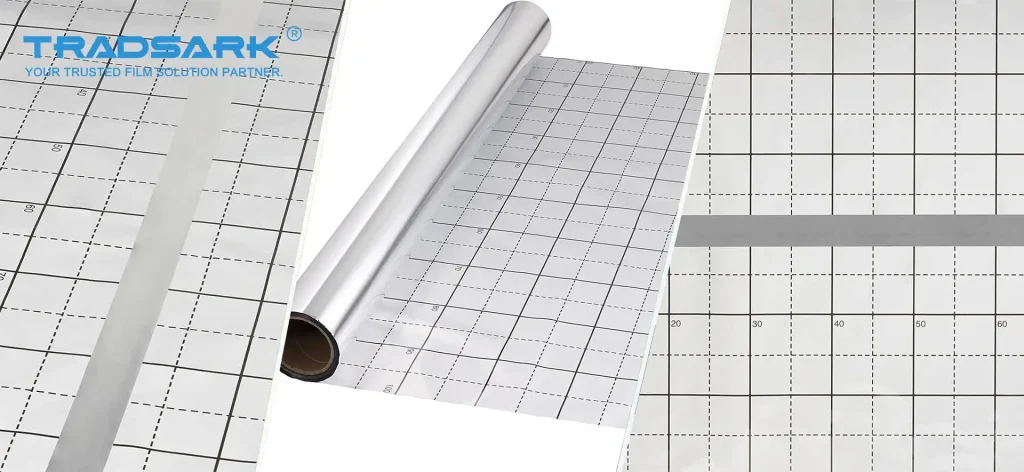
If you work in underfloor heating, HVAC accessories, building materials, or private label sourcing, you have probably already seen this product sold under many different names. Some sellers call it underfloor heating insulation film. Others call it reflective aluminium floor foil, grid film for floor heating, anti-moisture foil, steam brake film, or metallized insulation film for screed systems.
The names change, but the product is basically the same.
It is a reflective laminated film used over insulation boards and below screed in floor heating installations. In most cases, it is used in water-based underfloor heating systems. In some markets it is also discussed together with electric floor heating, although the final suitability always depends on the build-up of the system and the installer’s method.
From a factory point of view, this is not a complicated product category in theory. But from an importer’s point of view, it is often more difficult than it looks. The reason is simple: many rolls on the market look similar in photos, but they are not equal in material structure, thickness consistency, print quality, packaging, or commercial presentation.
That is exactly what we can see from the product information currently sold on Amazon in Germany and France. Different sellers present similar products with similar claims:
- moisture protection for insulation boards
- printed grid for easier pipe layout
- reflective surface for floor heating
- 1 meter or 1.02 meter width
- 50 meter roll length
- thickness around 0.07 mm to 0.13 mm
- silver surface with red grid print
- use under water-based floor heating systems
In other words, the market already has a recognizable standard. Buyers know what they are looking for. Installers know what they expect. Importers are not trying to invent a new product here. What they need is a supplier that can make the product consistently, package it properly, and support OEM or private label business without confusion.
That is where Tradsark fits in.
We manufacture reflective insulation film for underfloor heating applications in China for importers, distributors, wholesalers, and private label buyers. We also produce under our own brand and support OEM projects for overseas customers who need market-ready rolls, stable specifications, and clean packaging. In this business, buyers usually care less about dramatic claims and more about whether the film is actually easy to sell, easy to install, and stable over repeat orders.
What the Product Actually Does
On a job site, this film is usually laid over EPS or similar insulation boards. It sits under the heating pipe layout and below the screed layer. It is not meant to replace thick thermal insulation boards. That is not its role.
Its role is much more practical.
It gives the installer a cleaner working surface. It helps protect the insulation layer from moisture coming from wet screed or mortar. It gives a visible grid for laying out heating pipes more evenly. And depending on the system, the reflective metallized surface may help direct radiant heat upward rather than letting it disappear unnecessarily into the lower layers of the floor assembly.
This is why the same product is described in different ways in different countries. Some buyers focus on the grid print. Some focus on the vapour barrier function. Some focus on heat reflection. Some simply search for underfloor heating foil because that is the trade term they are used to.
All of those search terms point to the same real-world product family.
What We See in the European Market
The German and French marketplace data you shared is useful because it shows how this product is really being sold, not how people imagine it is sold.
We see a strong pattern:
- widths around 1.0 m to 1.02 m
- roll lengths around 50 m
- gross coverage around 50 m²
- common thicknesses around 0.10 mm, 0.105 mm, 0.11 mm
- red installation grid, usually 10 x 10 cm
- laminated structures such as PP / AL / LDPE or similar reflective constructions
- retail language focused on moisture protection, layout support, and reflective performance
We also see something else that experienced importers notice immediately: marketplace data is often messy.
Some listings confuse millimetres and microns. Some copy technical values incorrectly. Some use “aluminium foil” as a broad commercial phrase without clearly stating the actual laminate structure. One listing may talk about 50 m² correctly, while another makes an obvious calculation mistake. Some descriptions look like they were translated three times. This happens all the time in retail channels.
That is why buyers who import this product seriously do not make purchasing decisions from listing text alone.
They ask the factory for the real specification.
What Serious Buyers Usually Ask Us First
When a real importer contacts a factory about underfloor heating insulation film, the first questions are usually not abstract. They are practical.
They usually ask things like:
- Can you make 1 m x 50 m rolls?
- Can you supply 0.105 mm or 0.11 mm thickness?
- Is the grid clear enough for retail sale?
- Can you print our label in German or French?
- Can you pack rolls for Amazon, retail, or wholesale?
- Is the structure PP/AL/LDPE or metallized PP/PE?
- What is the roll weight?
- Can you keep the same quality on repeat orders?
- What is your MOQ?
- How long is the lead time?
That is why a good manufacturer page should not read like a school essay about floor heating. It should read like a sourcing page that understands the buyer’s next step.
Common Structures in This Product Category
From what is already being sold in Europe, the most common structures in this category include:
- PP / AL / LDPE
- PP / PE metallized laminate
- multilayer constructions using polypropylene and polyethylene with a reflective metallized layer
- anti-moisture laminated film with printed installation grid
For a distributor or importer, the exact structure matters because it affects more than one thing at the same time.
It affects how the roll opens on site.
It affects how easily the film tears.
It affects the feel of the surface.
It affects how the print looks.
It affects how the roll behaves during handling, transport, and installation.
And it affects how the product is perceived in the market.
A film can look bright and silver in a product photo and still be a weak commercial product. If the print is unclear, if the film feels too thin, if the lamination is unstable, or if the roll packaging looks cheap, customers notice. That matters even more if the buyer is reselling through Amazon or other online channels, where visual presentation and customer expectation are closely linked.
The Thickness Range Buyers Actually Care About
In this product category, we often see a commercial range from about 0.07 mm up to 0.13 mm. But in real business, not every thickness sells equally well.
The versions that appear most often in the market you shared are around:
- 0.10 mm
- 0.105 mm
- 0.11 mm
This makes sense.
These thicknesses usually give a practical balance between cost, handling, and market acceptance. Thinner film may reduce cost, but it can also feel less substantial in distribution and installation. Thicker film may feel more premium, but it changes roll weight, price position, and packaging dynamics.
Many importers do not actually want the “thickest possible” film. What they want is the thickness that fits their target market and sales channel.
A wholesaler selling into price-sensitive channels may prioritize cost and standard packaging.
A private label buyer selling online may prefer a slightly stronger presentation and cleaner roll quality.
A distributor targeting installers may care more about print clarity and handling stability than about a tiny difference in raw material price.
That is why sourcing this product should start with the target market—not only with the film itself.
Grid Printing Is Not a Small Detail
Buyers who are new to this category sometimes treat the red grid as a decorative feature. In reality, it is one of the most important selling points.
A clear 10 x 10 cm grid helps installers work faster and makes the product easier to explain in one photo. Some products also use finer guide marks such as 5 x 5 cm sections or broken lines to improve layout guidance.
The better the print, the more useful the product feels.
In OEM projects, we often see customers focus on grid presentation because it influences both installation value and retail presentation. A weak or blurry print can make the product look cheap even if the film itself is acceptable. A strong, clean red grid on a silver reflective surface gives the roll a more professional appearance immediately.
For private label buyers, this can make a real difference in online conversion.
For distributors, it helps the installer understand the value of the roll without extra explanation.
For chain-store packaging, it improves shelf appeal.
So yes, the grid matters. A lot.
Moisture Protection Is One of the Main Reasons the Product Exists
One thing that comes through very clearly in the market data you sent is how often sellers mention moisture protection. That is not accidental. It is one of the product’s most important practical functions.
When the film is laid over insulation boards and below screed, it helps protect the insulation layer from moisture exposure during installation. Depending on the product structure and installation practice, it also acts as a practical separating and protective layer in the floor assembly.
Different countries use different wording:
- vapour barrier film
- anti-moisture foil
- steam brake film
- insulation foil for screed
- moisture protection layer for underfloor heating
Heat Reflection: Better to Say It Honestly
This is a category where many websites become too aggressive. They start promising dramatic heating improvements or fixed energy savings from the film alone.
That usually does not sound professional.
A better and more believable way to talk about the reflective function is this:
The metallized surface is designed to help reflect radiant heat upward within the system build-up. In practical floor construction, this may help reduce unnecessary downward heat loss, but the final thermal result always depends on the complete floor assembly, insulation quality, screed design, and installation method.
That is closer to how real buyers think.
Distributors and importers usually do not want inflated promises. They want wording they can use safely in their own market. A responsible manufacturer should help them with that.
What Tradsark Can Supply
This is the part many generic articles leave too vague. So it is better to say it directly.
Tradsark supplies underfloor heating insulation film for OEM and export projects with options that can include:
- standard 1 m x 50 m rolls
- reflective laminated film structures for floor heating use
- common commercial thicknesses such as 0.10 mm, 0.105 mm, and 0.11 mm
- silver reflective surface with red installation grid
- standard or customized print layout
- neutral packing or private label packing
- multilingual labels
- retail, wholesale, and distributor-oriented packaging
Depending on the project, buyers may also request:
- custom roll width
- custom roll length
- custom sticker design
- carton artwork
- barcode-ready packaging
- multilingual instructions
- customized pallet marks
Some importers want a neutral product for bulk distribution.
Some want a private label line for e-commerce or Amazon.
Some want a product that visually matches the standard already seen in Germany, France, Poland, or other European markets.
That is why OEM flexibility is important.
What We Usually Recommend to Buyers
Not every buyer needs the same version.
If a customer is selling mainly through online retail, presentation becomes very important. The grid should be clear, the label should look professional, and the dimensions should be easy for customers to understand immediately.
If a customer is supplying installers or local distributors, consistency is often more important than marketing language. The roll should open cleanly, handle well, and match the standard installers are already used to.
If a customer is building a private label range, then packaging, naming, language, and brand presentation matter almost as much as the film structure.
This is why we usually recommend starting with these four questions:
- Which market are you selling to?
- Are you selling to installers, distributors, or e-commerce customers?
- Which thickness and roll size does that market already accept?
- Do you need neutral supply or private label packaging?
The clearer these points are, the easier it is to recommend the right commercial version.
Packaging Matters More Than New Buyers Think
Because this product is often sold as a roll, some buyers focus almost entirely on the film and forget the packaging.
That is a mistake.
Packaging affects:
- warehouse handling
- shelf presentation
- e-commerce photo quality
- label readability
- transport damage risk
- end-user trust
A good roll with weak packaging can still perform poorly in the market.
For OEM and private label projects, buyers often ask for:
- roll stickers with their brand
- outer carton labels
- multilingual usage text
- simple installation notes
- barcode labels
- pallet marks for warehouse identification
This is especially common for customers selling through Amazon or local DIY distribution.
Who This Product Is Usually Supplied To
In our experience, the most common buyer groups for this category include:
- building material importers
- floor heating accessory distributors
- HVAC wholesalers
- private label e-commerce brands
- Amazon sellers
- regional brands building a complete underfloor heating accessories line
- chain-store or retail sourcing teams
Each buyer group looks at the product slightly differently.
An importer may focus on landed cost and repeat-order consistency.
An Amazon seller may focus on label presentation and the way the grid looks in photos.
A distributor may focus on whether installers will accept it without complaint.
A retail buyer may care about the clarity of packaging and shelf presentation.
A supplier that understands these differences is much easier to work with.
What Importers Should Verify Before They Order
Before placing an order, buyers should usually verify the following:
Material structure
Do not rely only on the title “aluminium foil.” Ask for the actual laminate structure.
Thickness and tolerance
In this category, small differences matter. A few hundredths of a millimetre can change handling and market positioning.
Grid print quality
The print should be sharp, centered, and easy to read.
Roll dimensions
Confirm width, length, and roll weight clearly.
Packaging method
Ask how the rolls are packed and labeled.
Technical sheet
A real supplier should be able to provide technical documentation that makes sense.
OEM capability
If you want private label, confirm it early instead of treating it as an afterthought.
Common Marketplace Mistakes We See
One practical issue in this category is that marketplace data is often inconsistent. This is true in Europe and not unusual in other regions either.
Typical errors include:
- wrong coverage calculations
- thickness shown in the wrong unit
- technical values copied from another version
- vague use of “aluminium foil” without real structure explanation
- mixed-up product descriptions from different listings
That is why buyers should always confirm real specifications with the factory rather than relying only on marketplace text.
Why Many Buyers Still Source This Product from China
The answer is not complicated.
This category is already standardized enough to be produced efficiently, but it still leaves room for OEM differentiation in print, packaging, structure, and presentation. That makes China an attractive sourcing base for importers who need:
- stable production
- repeatable quality
- flexible OEM support
- custom packaging
- competitive manufacturing cost
- scalable supply for wholesale and retail channels
But of course, not every factory understands the export side of the business in the same way. Some can make film. Fewer can help build a product line that works commercially in the destination market.
Why This Page Is Written for Importers, Not Just for Search Engines
A lot of websites in this product category are written like generic keyword pages. They repeat the same phrases, say the same things, and never answer the real buyer questions.
That is not what importers need.
If you are sourcing underfloor heating insulation film from China, you are probably not looking for another shallow introduction to what floor heating is. You are trying to answer practical questions:
- Can this supplier match the product format my market already accepts?
- Can they make a stable OEM product?
- Can they support private label packaging?
- Can they explain the product honestly?
- Can I build repeat business on top of their supply?
RFQ Information That Helps Us Quote Faster
If you want an OEM or bulk quotation, the most useful first-step information usually includes:
- target market
- intended use: water-based or electric floor heating
- preferred thickness
- required roll size
- grid print requirement
- neutral or private label packaging
- label language
- estimated quantity
- destination country or port
This makes the conversation much faster and reduces unnecessary back-and-forth.
FAQ for Importers
What is the most common market size?
The most common commercial format is around 1 m x 50 m, giving about 50 m² gross coverage before overlap.
What thickness is most common?
The most common mainstream market versions are around 0.10 mm, 0.105 mm, and 0.11 mm.
Is it real aluminium foil?
That depends on the structure. Some products are described commercially as aluminium foil, while the actual construction may be a metallized laminated film. Buyers should always verify the real structure.
Is the red grid always 10 x 10 cm?
That is the most common format, but some products also use finer guidance lines.
Is this mainly for water underfloor heating?
Yes. That is the most common application, especially in systems using pipes, clips, and screed over insulation boards.
Can it be private labeled?
Yes. This category is well suited to OEM and private label projects.
What matters most in repeat business?
In practice, buyers usually care most about thickness consistency, print clarity, packaging quality, and reliable repeat supply.
Conclusion
Underfloor heating insulation film is not a new product, but it is still a product where details matter. The market already has a clear commercial standard, especially in Europe: reflective laminated construction, moisture protection, printed grid, common roll sizes, and practical presentation.
For buyers, the challenge is usually not finding a silver roll. The challenge is finding a supplier that understands the difference between a product that looks acceptable in a listing and a product that can be sold repeatedly in the real market.
Tradsark supplies underfloor heating insulation film as a China-based OEM manufacturer and supplier for importers, distributors, and private label buyers who need a practical, market-ready reflective grid film product line. If your goal is to build or expand a sellable underfloor heating insulation film range, the best place to start is with real specifications, realistic positioning, and a supplier that understands how the product is actually bought and sold.
