
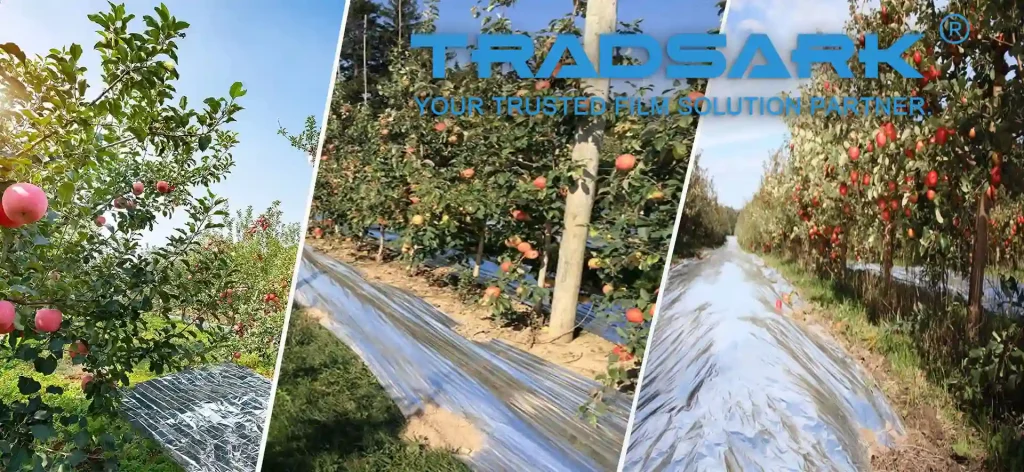
In orchard and greenhouse production, the real challenge is often not the total amount of sunlight available, but how efficiently that light reaches the lower and inner canopy. Many growers work in regions with strong sunshine overall, yet still face uneven apple coloration, shaded grape clusters, inconsistent ripening, or poor light penetration in greenhouse plants and flowers. Reflective agricultural film is used to redirect available sunlight from the ground back into the crop canopy, helping growers make better use of natural light where it matters most. Tradsark positions this product as a practical Agricultural Reflective Mylar Film solution for commercial orchards, vineyards, greenhouse operations, and distributors who need a usable material rather than a generic shiny roll.
In the market, buyers use different names for similar products. Some search for agricultural reflective mylar film, some for reflective PE film, some for reflective ground cover, and others for apple tree film or orchard reflective film. In practical field use, the name matters less than the performance. What buyers really need to know is whether the film reflects useful light, handles field installation well, survives orchard conditions, and helps support a better percentage of marketable fruit or more uniform plant development. Your existing Tradsark materials already make that point clearly: the core function remains the same across the terminology — improving light distribution, fruit coloration, and crop performance.
For importers, distributors, growers, and OEM buyers, the product decision is usually less about one marketing term and more about supply consistency, film structure, roll specification, handling convenience, customization, and whether the material can be positioned clearly for orchard, vineyard, greenhouse, or flower-market use. That is why Tradsark should be presented not only as a brand, but also as a practical agricultural reflective film manufacturer and supplier serving commercial horticulture and export-oriented agricultural material markets.
Why Light Distribution Matters in Commercial Fruit and Plant Production
Many crop quality problems begin as light-distribution problems. In orchards, the upper and outer canopy usually receives the strongest direct sunlight, while lower fruit and interior fruiting zones remain shaded for much of the day. In grapes, cluster zones may be affected by excessive canopy shading. In greenhouse crops and flower production, benches, containers, structural shading, and dense plant spacing can all reduce how much useful light reaches the lower parts of the crop. This uneven light environment often affects more than appearance. It can influence maturity, fruit finish, canopy balance, and the percentage of premium-grade produce that a grower can actually sell.
That is one reason reflective orchard-floor materials have become more common in professional horticulture. The Washington State University orchard floor management guidance explains that growers use reflective film materials on orchard floors to reflect sunlight back up into the trees to improve color on apples, cherries, and other stone fruit. In vineyards, the University of Georgia guidance on vineyard canopy light exposure reinforces the broader principle that better fruit-zone light exposure matters for crop quality. These external references do not mean every reflective film will perform the same in every crop system, but they do confirm the practical value of better orchard-floor and fruit-zone light management.
For apples and other premium fruit, better light distribution can help improve fruit finish, color consistency, and lower-canopy performance. For flowers and greenhouse crops, more balanced light can support more uniform plant development and stronger visual presentation. In both cases, reflective film is useful because it makes the ground surface active. Instead of letting sunlight disappear into dark soil, weeds, grass, or ordinary mulch, the reflective surface sends more usable light back upward into the crop zone.
What Agricultural Reflective Film Actually Is
Tradsark’s current reflective agricultural film range is built around practical field use. The product pages describe polyethylene (PE) or PE/PET reflective structures with a vacuum-deposited aluminum surface that creates a silver reflective finish. The film is designed to redirect visible light, and in higher-spec versions it is described as reflecting up to 95% of visible light and near-UV radiation. Standard orchard-oriented reflective PE products are positioned at more than 90% reflectivity and are commonly used for fruit trees, berries, vineyards, greenhouse floors, and shade-net agriculture.
Your existing materials also give a clear commercial specification range. Standard options include thicknesses of 15, 16, 18, 20, 25, and 30 microns, widths of 1 m, 1.2 m, 1.5 m, 2 m, 2.3 m, and 2.5 m, and roll lengths of 1200 m, 2000 m, and 3000 m. MOQ is listed at 500KG per size, and the materials also support custom thickness, width, length, OEM branding, and private-label supply. That makes the product more suitable for distributors and wholesale buyers than a one-size-fits-all retail roll.
Table 1 – Typical Tradsark Reflective Agricultural Film Specification Range
| Item | Typical Options |
|---|---|
| Material Structure | PE reflective film / PE-PET reflective film |
| Thickness | 15, 16, 18, 20, 25, 30 μm |
| Width | 1 m, 1.2 m, 1.5 m, 2 m, 2.3 m, 2.5 m |
| Length | 1200 m, 2000 m, 3000 m |
| Reflectivity | >90% standard orchard reflective film; up to 95% for higher-spec PE/PET reflective film |
| MOQ | 500KG per size |
| Supply Mode | Standard rolls, OEM, private label, customized sizes |
The product pages also make an important distinction: if the film is used for fruit trees, it is usually supplied as an aluminized reflective film; if the application is strawberry soil coverage, black PE film may also be relevant depending on whether the main goal is light reflection or weed suppression. That is useful for professional buyers because it prevents confusion between reflective orchard film and standard black mulch. For buyers looking for a broader material entry point, Tradsark also presents this product direction through its Metalized PE Film page, which is useful when discussing metallized PE structures in orchard and agricultural applications.
Tradsark Reflective Agricultural Film: Product Structure, Materials, and Supply Flexibility
Tradsark should be described consistently as a manufacturer and supplier rather than just as a trading brand. Your product pages position Tradsark New Materials (Weifang) Co., Ltd. as a manufacturer of high-performance films including BOPP, CPP, PET, metallized films, reflective PE films, insulation materials, agricultural films, and related products. That manufacturing background helps support the orchard and greenhouse reflective film line because it shows that the company works with the underlying film structures, not only with resale packaging.
The core technical story is also consistent across your pages:
- vacuum metallization creates the reflective surface
- PE or PE/PET structures provide strength, flexibility, and handling practicality
- standard reflective PE products emphasize cost-effective orchard use
- higher aluminum PE/PET products emphasize stronger reflectivity and higher-spec use cases
- customization is available for thickness, width, roll length, and labeling
- OEM and private label support are available for distributors and importers
This is important because buyers in North America and South America often do not want only a raw film roll. They want a supplier who can provide stable specifications, repeatable quality, and export-ready supply support.
PE Reflective Film for Seasonal Orchard Use
PE reflective film is often the more practical choice for orchard ground use where flexibility, field handling, and seasonal deployment matter most. Your product pages repeatedly frame orchard reflective film for fruit trees as aluminized PE film, which fits well with how many growers actually use the product: they want a reflective film that can be rolled out quickly, adapted to orchard floor conditions, and used cost-effectively during the fruit-finishing period. PE reflective film is especially relevant where ease of installation and workable seasonal cost are priorities.
PE/PET Reflective Film for Higher-Spec Applications
Your higher aluminum layer PE/PET reflective film page supports a slightly different positioning. It describes a composite agricultural material with an aluminum layer typically 300–500 Å thick, reflectivity up to 95%, and suitability for apples, vineyards, strawberries, citrus, and greenhouse crops. These PE/PET or PET-leaning reflective structures can be presented as more suitable where buyers want a firmer film body, higher reflectivity claims, or a more premium product story for certain export or reseller markets. Buyers who want to present a stronger reflective and higher-spec orchard solution can naturally connect this discussion with Tradsark’s High Aluminum Layer Mirror Reflective Film Agricultural PE PET Film for Apple Orchard product page.
Why Apples Remain the Strongest Commercial Use Case
Among all crops, apples remain the clearest and strongest use case for reflective orchard film. Your Apple Tree Film page is already built around this application and explains that the product is designed to improve the orchard micro-environment through optical regulation, enhancing fruit quality, more uniform coloration, and yield. It also directly mentions orchard conditions in China and Washington State, USA, which makes the product commercially relevant in both domestic and North American apple markets.
That positioning makes practical sense. In fresh-market apples, size is not the only selling point. Color, skin appearance, finish, and ripening uniformity all affect grading and final value. A block can produce a healthy crop, but if lower and interior fruit do not develop strong, marketable coloration, a meaningful share of the harvest may lose premium value. Reflective orchard film is attractive because it helps use natural light more effectively in those lower and inner fruiting zones. Your orchard content also correctly notes that reflective film works best as part of a managed orchard system, not as a substitute for pruning, canopy management, or good harvest timing.
This is especially relevant in the United States and Canada. The latest USDA apple production outlook shows how large the U.S. apple market remains, while Statistics Canada fruit production data confirm the continuing importance of apples in Canada’s fruit sector. For orchard buyers in these markets, reflective film is best positioned as a fruit-quality management tool rather than as a miracle input. It works best in orchards that already have reasonable pruning, canopy structure, and harvest management.
Reflective Film for Grapes, Vineyards, Berries, and Citrus
Grapes are another important commercial use case, especially in South America. Your product pages list grapes and vineyards among the key applications, and this fits the logic of export-oriented fruit production where color, sugar development, ripening consistency, and appearance all matter. The USDA FAS Peru grape export report highlights the scale and momentum of Peru’s grape sector, which helps explain why practical fruit-quality support materials can matter in that region.
Your current material also supports berries and citrus as valid applications. For berries, the distinction between reflective silver film and black PE film is commercially important: reflective film is about light redistribution, while black PE is more often about weed control and soil management. For citrus, better reflected light can support more even peel coloration and better visual quality in premium fresh-fruit channels.
Table 2 – Typical Application Matching
| Application | Recommended Direction |
|---|---|
| Apple orchards | Aluminized PE reflective film for orchard floor light return |
| Vineyards | Reflective agricultural film for improved fruit-zone light conditions |
| Citrus orchards | Reflective ground cover for more even fruit appearance |
| Berry cultivation | Reflective film or black PE depending on light or weed-control priority |
| Greenhouse plants and flowers | Reflective floor film for better light distribution in protected cultivation |
| Importer / distributor supply | OEM reflective agricultural film with custom size and label support |
Greenhouse, Flower, and Plant Applications in North America
This is an important growth direction for your export business. You specifically noted that in the U.S. market the product is used not only for apples, but also for plants and flowers. That direction is commercially credible. The latest USDA floriculture market data show the size of the U.S. floriculture sector, and your own product pages mention greenhouse floors, shade-net agriculture, improved light intensity, and support for year-round cultivation. This gives you a solid basis to position Tradsark reflective agricultural film for greenhouse plants, ornamental crops, and flower production where more even light distribution is valuable.
In greenhouse settings, buyers usually care about:
- better use of natural light
- more even plant growth
- improved visual quality in ornamental crops
- reduced shading under benches or dense layouts
- a clean, practical, reflective floor material
- lower dependence on added lighting in some setups
Those are realistic and commercially meaningful benefits. Your higher-spec reflective PE/PET page also explicitly states that the product can help reduce the need for supplemental lighting in greenhouse environments, which strengthens this use case when it is described carefully and not exaggerated.
What Importers and Distributors Should Evaluate Before Purchase
For importers, distributors, and OEM buyers, the decision is rarely based on one marketing term alone. The more useful buying questions are:
- Is the film structure suitable for orchard, vineyard, greenhouse, or plant use?
- What thickness, width, and roll length best fit the target market?
- Is the reflectivity realistic and supported by the product design?
- How long is the expected useful field life under real conditions?
- Is the film easy to install, anchor, reroll, and store?
- Can the supplier support OEM labeling and private label requests?
- Is MOQ practical for a first shipment or market trial?
Your orchard article already points buyers toward the right evaluation logic: compare reflectivity, tear resistance, weather stability, roll format, installation practicality, and realistic field life rather than glossy marketing descriptions alone.
Thickness, Width, and Roll Length
Tradsark’s standard range already gives importers flexibility: 15–30 μm thickness, 1–2.5 m width, and 1200–3000 m length. These dimensions are practical because they let buyers adapt the film to orchard spacing, greenhouse layout, logistics, and local distributor preferences.
Reflectivity, Outdoor Life, and Reuse Expectations
Reflectivity is an important selling point, but it should not be treated as the only one. Your product pages describe more than 90% reflectivity for orchard reflective PE film and up to 95% for higher-aluminum PE/PET film. Outdoor life should be explained carefully: standard PE-based orchard films are currently positioned around 6–12 months outdoor durability, while PE/PET or higher-spec reflective structures may support 1–3 growing seasons under suitable handling, UV package, and climate conditions. Reuse potential is also presented in your pages, but it should always be framed as product- and use-dependent rather than promised universally.
OEM, Private Label, and MOQ
MOQ is listed as 500KG per size, and the current Tradsark product pages explicitly support custom labeling, OEM branding, and custom roll specifications. For distributors and private-label buyers, that is one of the strongest commercial advantages because it allows the reflective agricultural film line to be adapted to local branding and reseller needs rather than sold only as a generic imported roll.
Installation and Field Use
Reflective agricultural film works best when it is installed correctly and used in the right crop stage. Your product pages recommend placing the reflective side upward, rolling the film between orchard rows, maintaining slight tension, and using stakes or anchors where needed. The higher-spec PE/PET page also recommends 5–10 cm overlap for more complete coverage. In greenhouse use, the film can be laid on the floor or between crop rows and secured with clips or simple anchoring. Keeping the surface reasonably clean is important because dirt accumulation reduces reflectivity.
In practice, many growers use reflective orchard film during the period when fruit finishing and coloration become commercially important rather than for the entire season. This makes the product especially attractive as a targeted quality-support material rather than a permanent infrastructure investment.
Common Buying Mistakes to Avoid
Buying only on price
A cheaper roll is not always the lower-cost solution if it tears easily, wrinkles badly, loses reflectivity quickly, or is harder to handle in the field. Practical usable life matters more than headline price alone. Your orchard article already moves buyers in this direction by encouraging comparison based on usable field life, reflectivity retention, and handling efficiency.
Confusing reflective film with black mulch
Black PE has an important role in agriculture, especially for weed suppression and some strawberry systems, but it is not the same as orchard reflective film designed to improve canopy light. Your own product pages clearly separate these use cases.
Expecting film to replace canopy management
Reflective film is useful, but it works best in orchards and vineyards that already have reasonable pruning, canopy openness, and harvest timing. It is a support tool, not a substitute for good crop management.
Ignoring OEM and packing needs
For distributors, the product is also a logistics and branding item. Roll length, pallet plan, labels, and private-label packaging may matter just as much as the reflective layer itself.
FAQ
What is the difference between reflective PE film and PE/PET reflective film for orchard use?
Reflective PE film is often preferred for practical seasonal orchard use because of its flexibility and easier field handling, while PE/PET reflective structures may be considered where stronger film body, higher reflectivity, or higher-spec positioning is required.
Is Tradsark reflective film mainly used for apple orchards?
Apple orchards are one of the strongest commercial use cases, but the product is also suitable for grapes, citrus, berries, greenhouse crops, plants, and flowers where reflected light can support better canopy light conditions.
What thickness options are available?
Tradsark currently offers agricultural reflective film in 15, 16, 18, 20, 25, and 30 microns, depending on crop type, handling expectations, and project needs.
What is the MOQ?
The standard MOQ listed in current product materials is 500KG per size.
Can the film be customized for importers or distributors?
Yes. Tradsark supports customization for thickness, width, roll length, OEM labeling, and private-label supply for distributors, importers, and agricultural material buyers.
How long can reflective agricultural film last outdoors?
Expected outdoor life depends on film structure, UV package, local climate, and handling conditions. In Tradsark’s current range, standard PE-based orchard films are usually positioned for seasonal outdoor use, while higher-spec PE/PET reflective structures may support longer reuse under suitable conditions.
Why Tradsark Is a Practical Agricultural Reflective Film Manufacturer and Supplier
Agricultural reflective film, reflective PE film, orchard reflective film, and apple tree film all belong to the same practical category of agricultural light-management materials. They help growers, greenhouse operators, importers, and distributors make better use of natural light by redirecting it into the canopy zones that often need it most. When matched to the right crop system and field conditions, reflective film can support better fruit coloration, more balanced light distribution, stronger crop uniformity, and improved commercial value.
For apples, the use case is especially strong. For grapes, berries, citrus, greenhouse crops, plants, and flowers, the opportunity is also real where light distribution affects appearance, ripening, and market quality. As an agricultural reflective film manufacturer and supplier, Tradsark positions its product range not as a generic shiny roll, but as a practical material solution for orchard, greenhouse, and horticultural applications. With flexible specifications, OEM options, and export-oriented supply capability, Tradsark supports growers, importers, distributors, and private-label buyers looking for a more usable reflective film platform in real agricultural markets.
