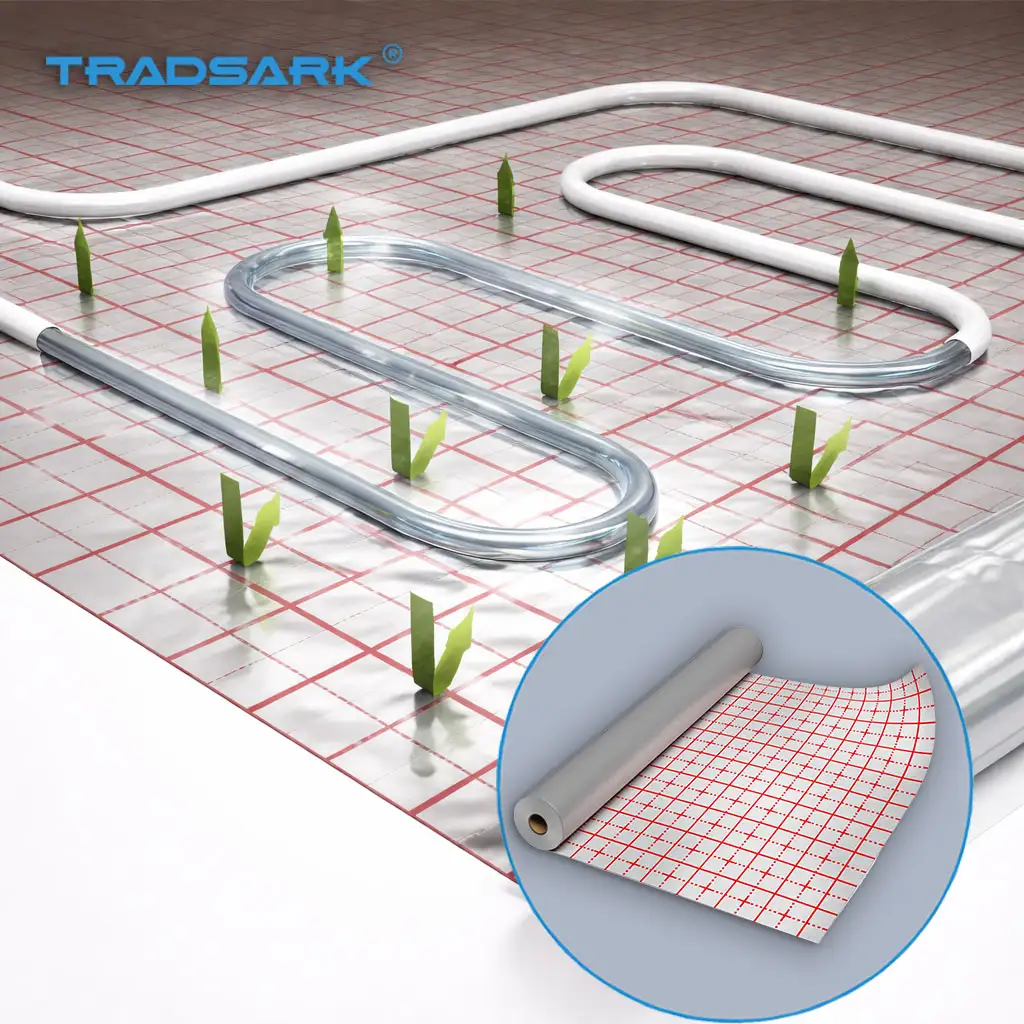
Product Scope in UFH Build-Ups
An underfloor insulation heating membrane is typically installed on the prepared subfloor (concrete slab, base screed, renovation substrate), beneath UFH pipes/cables and their fixing system, and beneath screed or self-leveling compound in many common build-ups. It is designed to be a practical, jobsite-ready composite laminate that supports consistent installation quality.
What this membrane is designed to do
- Radiant heat reflection support: The aluminum foil core acts as a radiant reflector; project-specific reflectivity/emissivity data can be provided upon request with declared test methods and conditions.
- Vapor/moisture control support: polymer layers plus sealed seams help reduce moisture migration through the floor assembly.
- Mechanical protection: protective film layers help resist puncture/tear damage during handling and installation.
- Cement-alkali tolerance support: protective polymer surfaces are selected for typical cementitious environments.
- Dimensional stability support: stable film selection and lamination integrity reduce wrinkling and seam instability.
What this membrane is not
- Not a replacement for rigid insulation boards (EPS/XPS/PIR) where codes or engineering design require measurable thermal resistance (R-value/U-value).
- Not a wet-room waterproofing system unless the entire build-up (including detailing) is designed and tested as waterproofing.
Important engineering boundary condition
Radiant reflection performance depends on the installation build-up (e.g., air gap vs. full contact, surface emissivity, and construction layers). This membrane is specified primarily as a reflective & protective layer within the floor assembly—project performance is determined by the complete design (including insulation boards where required, seam sealing, perimeter detailing, and screed specification).
Standards & Compliance References
European projects often require product information aligned with recognized standards. For UFH membranes, it is important to reference the correct type of standards: (1) UFH system standards define system design and installation context, while (2) material test methods define how to measure film/laminate parameters (tensile, WVTR, peel, thickness, etc.). Tradsark can provide project documentation and third-party test reports based on your target EU market and specification.
Table 1 – UFH System Standards
| Standard Family | Scope (High Level) | Why referenced on this page |
|---|---|---|
| EN 1264 series | Water-based surface embedded heating/cooling systems; design and thermal output determination (parts vary). | Provides Europe-oriented engineering context for UFH build-ups and installation principles. |
| ISO 11855 series | ISO 11855 series (Parts 1–6) is used internationally for embedded radiant heating/cooling systems (example link: Part 6). | International framework used alongside national practices and project specifications. |
Table 2 – Material Test Methods
| Property / Topic | Typical Standard / Reference | What it measures | What must be declared in reports |
|---|---|---|---|
| Tensile properties of films (< 1 mm) | ISO 527-3 | Tensile strength and strain of plastic films/sheets. | Conditioning + specimen description + thickness + MD/TD values. |
| Water Vapour Transmission Rate (WVTR) | ISO 2528 | WVTR by gravimetric dish method. | WVTR values must be reported with declared temperature/RH and method details, as results are not comparable without consistent conditions. |
| Thickness control (QC reference) | Project-defined method | Thickness consistency for converting and acceptance. | Instrument type + sampling plan + tolerance approach. |
| Peel / lamination adhesion (tie layer integrity) | Agreed method (project or internal reference) | Bond integrity between layers to reduce delamination risk. | Test method, sample size, conditioning, result format (e.g., N/25mm). |
| Foil integrity / pinhole inspection | Project criteria | Checks for foil cracking, pinholes, edge damage, wrinkles. | Sampling rule + acceptance criteria + photo record if required. |
Compliance wording recommended for EU export: “Testing and documentation can be provided based on the target market and project specification, including third-party reports upon request.” Avoid claiming “certified to all standards” unless documented for the specific market.
Regulatory & site compliance notes
- REACH / RoHS: Project-specific declarations can be provided upon request for EU procurement files.
- Fire behavior (common project request): Reaction-to-fire classification requests (e.g., EN 13501-1) should be confirmed per target market and project scope; testing can be arranged upon request if required by the specification.
- Building assembly responsibility: Final compliance is determined by the complete floor build-up and site installation practice, not by a single layer alone.
5-Layer Composite Architecture
All Tradsark UFH membranes use a 5-layer laminate structure:
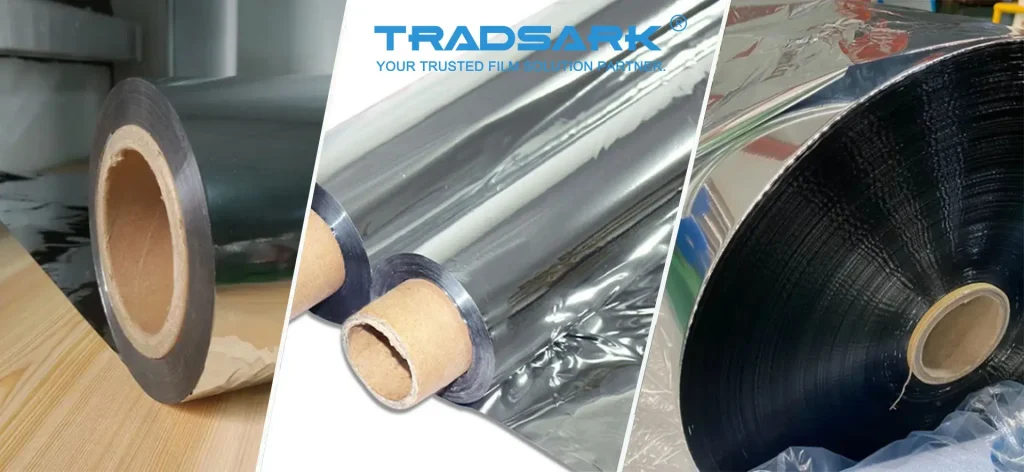
Protective Film / Adhesive / Aluminum Foil / Adhesive / Protective Film
Structure names (e.g., PET/AL/PE) describe the three functional material layers; the full construction is a 5-layer laminate including two adhesive tie layers.
Functional roles
- Aluminum foil core: radiant reflector; contributes to barrier continuity when seams and perimeters are sealed.
- Protective polymer layers (BOPP / PET / PE): mechanical strength, abrasion resistance, moisture resistance, and tolerance for cementitious environments.
- Adhesive tie layers: lamination integrity; reduces delamination risk under construction moisture and temperature variation.
All Three Structures Available
Tradsark supplies all three mainstream structures widely used in the construction market and exports to Europe based on project requirements. Each structure has a practical best-fit scenario.
Table 3 – Structure Options Overview
| Structure | Layer Stack (Top → Bottom) | Strength Focus | Typical EU Use Case |
|---|---|---|---|
| BOPP/AL/BOPP (most universal) | BOPP + ADH + Aluminum Foil + ADH + BOPP | Moisture resistance + cost-performance + jobsite practicality | General residential & standard commercial UFH |
| PET/AL/PET (higher-end durable) | PET + ADH + Aluminum Foil + ADH + PET | Tensile + puncture resistance + dimensional stability | Large areas, heavy site traffic, longer exposure before screed |
| PET/AL/PE (tile / thin leveling bias) | PET + ADH + Aluminum Foil + ADH + PE | Robust top face + interface-oriented selection for thin builds | Tiles/stone, thin screed, self-leveling builds (orientation controlled) |
Installation note: PET/AL/PE is asymmetric. Installers must follow “This Side Down” marking to ensure the intended interface faces the substrate. Orientation control is a compliance point and should be recorded in site QA files.
Standard Specification
Tradsark’s standard supply for European export includes three selectable total thicknesses and two common foil thickness options.
Table 4 – Standard Thickness & Foil Options
| Total Thickness (mm) | Aluminum Foil Thickness (μm) | Availability |
|---|---|---|
| 0.35 | 7 / 9 | Standard selectable |
| 0.45 | 7 / 9 | Standard selectable |
| 0.55 | 7 / 9 | Standard selectable |
How to interpret thickness choices
- 0.35 mm: selected for thinner build-ups and renovation constraints.
- 0.45 mm: general-purpose thickness for many residential and commercial jobs.
- 0.55 mm: chosen where higher robustness is desired (longer exposure on site, higher mechanical stress).
Why foil thickness matters (7 μm vs 9 μm)
- 7 μm: common for standard projects with controlled handling and shorter exposure before screed.
- 9 μm: preferred for tougher sites and higher handling stress, helping reduce foil damage risk.
Supply Dimensions & Converting Options
Roll sizes vary by market preference and installer handling needs. Tradsark supports standard and OEM sizes for EU export.
Table 5 – Typical Roll Sizes & Optional Features
| Item | Typical Standard | OEM / Project Options |
|---|---|---|
| Roll width | 1.0 m / 1.2 m / 1.5 m | Custom widths upon request |
| Roll length | 25 m / 50 m | Custom lengths |
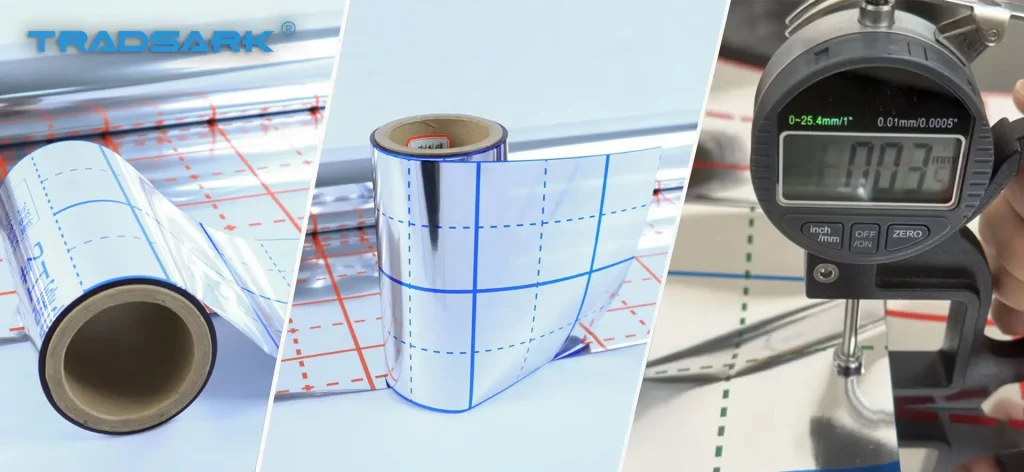
| Grid printing | Optional | Grid spacing/color, private label |
| Cutting/slitting | Standard converting | Project-specific widths |
| Packaging | Export pallet wrap | Retail packs, mixed pallets |
Palletization plan (rolls per pallet, pallet height, and container loading estimate) can be provided with the packing list for each order.
Performance Data: Real & Auditable Reporting Approach
EU procurement teams typically prefer data presented as (1) fixed product facts (structure, thickness, foil thickness), and (2) test-reported properties (tensile, WVTR, peel), including test methods and conditions. This avoids inflated claims and keeps documentation consistent with recognized test frameworks.
Table 6 – Facts vs. Reported Properties
| Category | Product Facts | Verified via Test Report |
|---|---|---|
| Construction | 5-layer laminate; 3 structures; thickness 0.35/0.45/0.55 mm; foil 7/9 μm | — |
| Mechanical behavior | PET-based structures are typically selected for higher robustness vs BOPP-based structures | Tensile to ISO 527-3 (MD/TD) if required |
| Moisture/vapor behavior | Composite supports vapor control when seams and perimeters are sealed | WVTR to ISO 2528 with declared conditions if required |
| Lamination integrity | Designed with adhesive tie layers to reduce delamination risk | Peel / adhesion report per agreed method if required |
| System context | Compatible with hydronic and electric UFH build-ups | UFH system design follows EN 1264 / ISO 11855 (project responsibility) |
Table 7 – Recommended EU Test Report Template Fields
| Test Item | Standard / Reference | Report should include |
|---|---|---|
| Tensile (MD/TD) | ISO 527-3 | Film type, thickness, conditioning, specimen description, MD/TD values |
| WVTR | ISO 2528 | Temperature/RH/method, specimen description, results |
| Peel / adhesion | Agreed method | Conditioning, sample prep, result format (e.g., N/25mm), pass/fail criteria if defined |
| Visual inspection | Project criteria | Pinhole/foil integrity notes, edge damage, wrinkles; sampling record |
| Thickness | Project method | Instrument type, sample count, average and tolerance approach |
| Basis weight (optional) | COA field | g/m² with sampling plan (useful for receiving inspection) |
Technical Specification Matrix
The matrices below present Tradsark’s structures in an EU procurement style: deliverable specifications (thickness/foil), typical roll formats, best-fit scenarios, and verification mapping (test methods or acceptance checks).
Matrix A — BOPP/AL/BOPP
| Item | Standard Offer | Typical Roll Formats | Best-fit Scenarios (EU) | Verification / Mapping |
|---|---|---|---|---|
| Structure | BOPP / ADH / Al foil / ADH / BOPP | 1.0/1.2/1.5 m × 25/50 m | General residential UFH, standard commercial projects | Incoming material spec + COA + visual roll inspection |
| Total thickness | 0.35 / 0.45 / 0.55 mm | Common: 1.2 m × 50 m | Renovation / general purpose / higher robustness as selected | Thickness QC method + sampling plan (COA) |
| Foil thickness | 7 / 9 μm | As ordered | 7 μm (standard), 9 μm (tougher site handling) | Visual foil integrity + batch record |
| Grid printing | Optional | 5 cm / 10 cm (typical) | Faster layout & cutting efficiency | Visual printing inspection + agreed tolerance |
| Seam recommendation | Foil tape sealing recommended | — | Projects requiring vapor continuity strategy | Site checklist: seams sealed before pour |
Matrix B — PET/AL/PET
| Item | Standard Offer | Typical Roll Formats | Best-fit Scenarios (EU) | Verification / Mapping |
|---|---|---|---|---|
| Structure | PET / ADH / Al foil / ADH / PET | 1.0/1.2/1.5 m × 25/50 m | Large areas, heavy traffic, longer exposure before screed | COA + enhanced incoming inspection + optional tensile report |
| Total thickness | 0.35 / 0.45 / 0.55 mm | Common: 1.2 m × 50 m | Durability-driven selection by schedule and jobsite conditions | Thickness QC + site protection plan when needed |
| Foil thickness | 7 / 9 μm | As ordered | 9 μm for reduced damage risk in harsher handling | Visual foil integrity + lamination integrity checks |
| Dimensional stability focus | PET layers typically offer better stability | — | Projects sensitive to seam stability and flatness | Flatness inspection + seam continuity checklist |
Matrix C — PET/AL/PE
| Item | Standard Offer | Typical Roll Formats | Best-fit Scenarios (EU) | Verification / Mapping |
|---|---|---|---|---|
| Structure | PET / ADH / Al foil / ADH / PE | 1.0/1.2/1.5 m × 25/50 m | Tile/stone finishes, thin screed/self-leveling builds | Orientation control required (asymmetric structure) |
| Total thickness | 0.35 / 0.45 / 0.55 mm | Common: 1.2 m × 50 m | Thin-build and finish-driven selection | Thickness QC + orientation sign-off |
| Foil thickness | 7 / 9 μm | As ordered | 9 μm for tougher sites or reduced damage risk | Visual foil integrity + batch record |
| Orientation | Marked “This Side Down” | — | Ensures intended interface faces substrate | Site QA: photo record per zone/room |
| Seam sealing | Foil tape sealing recommended | — | Continuity under tiles/thin screed | Site checklist: seams + perimeter sealed |
Quick selector: Universal projects often choose BOPP/AL/BOPP (0.45 mm). High-abuse sites often choose PET/AL/PET (0.55 mm). Tile/thin screed builds often choose PET/AL/PE (0.35–0.45 mm), with strict orientation and seam control.
Documentation Pack for EU Buyers
EU buyers typically request a documentation pack that supports receiving inspection, traceability, and project filing. Tradsark can provide documentation based on market and project requirements.
Pack A — Standard Export Documents
| Document | Purpose | Typical Contents | Provided When |
|---|---|---|---|
| Proforma / Commercial Invoice | Customs & payment | Description, quantity, unit price, total, shipment terms | Every shipment |
| Packing List | Warehouse receiving | Roll count, pallet count, gross/net weight, package dimensions | Every shipment |
| Bill of Lading / AWB | Logistics proof | Carrier, container/airway details | Every shipment |
| COA (Certificate of Analysis) — Batch | Technical acceptance | Thickness, roll format, visual inspection summary, batch ID | Recommended for EU projects |
| Batch Traceability Statement | Audit trail | Batch mapping to production records and raw material lots | Recommended |
| Technical Data Sheet (TDS) | Engineering reference | Structures, thickness/foil options, roll sizes, installation notes | Recommended |
| Storage & Handling Guide | Site reliability | Storage conditions, handling do/don’t, labeling policy | Recommended |
| Regulatory Declarations (EU) | Compliance file | REACH / RoHS declarations (market-dependent) | Upon request |
Pack B — Test Reports
| Test / Report | Standard Reference | Why it may be required | Notes |
|---|---|---|---|
| Tensile (MD/TD) | ISO 527-3 | Specifiers requiring mechanical proof | Report must state conditioning and specimen details |
| WVTR | ISO 2528 | Moisture-control requirement in floor build-up | Report must state temperature/RH/method |
| Peel / adhesion | Agreed method | Delamination risk management | Define acceptance criteria in the project spec |
| Reaction-to-fire classification (if required) | EN 13501-1 (project request) | Often requested in EU projects | Confirm scope with the buyer; testing arranged upon request |
Template — COA Fields
| COA Item | Field Name | Example Format |
|---|---|---|
| Product | Product Name | Tradsark® 5-Layer UFH Reflective Membrane |
| Structure | Structure Type | BOPP/AL/BOPP or PET/AL/PET or PET/AL/PE |
| Thickness | Total Thickness | 0.35 / 0.45 / 0.55 mm |
| Foil | Foil Thickness | 7 μm / 9 μm |
| Roll | Roll Width × Length | 1.2 m × 50 m |
| Quantity | Rolls / Pallets | 200 rolls / 10 pallets |
| Batch | Batch No. | TS-UFH-YYYYMM-XXXX |
| Production | Date / Line | YYYY-MM-DD / Line # |
| Visual | Appearance | Pass/Fail (pinholes, wrinkles, edge damage) |
| Packaging | Export Packing | Pallet wrap + corner protection |
| Remarks | Notes | Orientation marking (PET/AL/PE); seam tape recommendation |
Template — Packing List Fields
| Packing List Field | Example / Notes |
|---|---|
| Consignee / Destination | EU customer warehouse address |
| Product | Tradsark® UFH Membrane |
| Structure | BOPP/AL/BOPP (or PET/AL/PET, PET/AL/PE) |
| Thickness / Foil | 0.45 mm / 9 μm |
| Roll size | 1.2 m × 50 m |
| Rolls per pallet | Per order (declare actual number) |
| Pallet height (mm) | Per order (declare actual height) |
| Container loading estimate | Per order (20GP/40HC estimate based on roll & pallet plan) |
| Net/Gross weight | kg |
| Package dimensions | L × W × H |
| Batch numbers | Listed per pallet |
| Handling notes | Keep dry; avoid puncture; do not exceed stack limit |
Design Integration Notes
This section explains how the membrane interacts with typical UFH components and floor build-ups. It focuses on practical outcomes: seam continuity, jobsite survivability, and compatibility with thin/standard screed approaches. The membrane supports reflection and continuity strategies, but overall system performance depends on the complete assembly (including insulation boards where required by design/codes).
1) Where the membrane sits in common UFH build-ups
- Hydronic UFH (wet system): membrane → pipe fixing system → screed.
- Electric UFH (cable/mat): membrane → cable/mat fixing → leveling compound or screed.
- Renovation systems: membrane often paired with thin build-up solutions where height is limited.
2) Thin screed vs. standard screed
Thin screed / self-leveling builds are more sensitive to surface flatness, wrinkles, and seam edges. The membrane must lay flat and remain stable during pouring. In such projects, contractors often prefer PET/AL/PE (tile/thin-screed bias) or PET/AL/PET for tougher sites. Seam tape should be applied cleanly without raised ridges that might telegraph through thin layers.
Standard screed builds are more forgiving of minor surface irregularities but still depend on puncture avoidance and seam continuity. BOPP/AL/BOPP is frequently selected for cost-performance balance; PET/AL/PET is chosen where the schedule or site conditions are harsher.
3) Tile/stone vs. wood/LVT
Tile/stone finishes are often paired with thin leveling layers and require careful interface control to avoid voids. Seam continuity and damage prevention matter because defects can create local weak points under rigid finishes. PET/AL/PE or PET/AL/PET are commonly selected for these projects, alongside strict seam and perimeter sealing procedures.
Wood/LVT or floating floors may involve different moisture-control and acoustic strategies. The membrane should be selected based on moisture risk and jobsite durability requirements.
4) Ground moisture risk and vapor continuity
In ground-floor slabs or renovation projects, moisture migration may be a design concern. The membrane can support vapor continuity only if seams and perimeters are sealed and the overall floor design addresses moisture sources. Practical design points include defining the seam sealing method (foil tape), overlap rule, and perimeter detailing around penetrations and walls. The membrane should be treated as part of a broader moisture strategy, not as a standalone waterproofing claim.
5) Compatibility with UFH fixing systems
The membrane must remain stable under foot traffic during pipe/cable fixing, clip/fastener installation, and movement of installers and tools. For clip-intensive installations and rough sites, contractors often prefer PET/AL/PET to reduce tear risk. Standard residential installations with controlled conditions frequently use BOPP/AL/BOPP.
6) Recommended specification language
Example tender line: “5-layer reflective UFH insulation membrane, structure: BOPP/AL/BOPP (or PET/AL/PET or PET/AL/PE), total thickness 0.45 mm, aluminum foil 9 μm, roll size 1.2 m × 50 m, seam sealing with aluminum foil tape, documentation pack including COA and batch traceability; project test reports available upon request (ISO 527-3 tensile, ISO 2528 WVTR with declared conditions).”
Quality Control & Field Failure Prevention
Most jobsite issues are not caused by “headline efficiency.” They are caused by practical failures: delamination, pinholes/foil cracking, seam discontinuity (untaped or damaged seams), puncture damage before screed, and excessive wrinkling that creates uneven contact. Tradsark QC is oriented to reduce these risks.
Table 8 – Practical QC Checklist
| Inspection Item | Why it matters | Typical control |
|---|---|---|
| Thickness consistency | Predictable build-up and converting stability | Batch sampling + COA |
| Foil integrity | Reflective/barrier continuity | Visual + sampling inspection |
| Lamination integrity | Reduces delamination risk under moisture/temperature | Peel/adhesion reference checks (project-specific if required) |
| Roll edge & winding | Installer efficiency; reduces waste | Winding/edge QC + packaging QC |
| Optional project tests | Compliance documentation for specifiers | ISO 527-3 tensile / ISO 2528 WVTR / adhesion upon request |
Installation Guidance
UFH system standards define system context, but reflective membranes succeed mainly through seam continuity and damage prevention. The steps below reflect jobsite best practice.
Recommended installation steps
- Subfloor preparation: clean, dry, remove sharp debris and protrusions.
- Lay membrane flat: unroll with minimal wrinkles; trim cleanly around penetrations.
- Confirm orientation: PET/AL/PE must follow “This Side Down” marking; record photo per zone if required by QA.
- Seal seams: use aluminum foil tape for continuity; seal overlaps and perimeters.
- Perimeter detailing: use perimeter insulation strips where required to reduce thermal bridging.
- Protect before screed: use temporary boards in high traffic zones to reduce punctures.
- Proceed with UFH fixing + screed: follow UFH supplier and screed manufacturer procedures.
Table 9 – Common Installation Mistakes & Prevention
| Issue | What it looks like on site | Practical prevention |
|---|---|---|
| Unsealed seams | Overlaps without tape; visible gaps | Tape seams; inspect before pour |
| Puncture damage | Small holes from debris/tools | Clean substrate; protect traffic paths; patch damage |
| Wrinkling | Uneven surface under pipes | Lay flat; manage roll tension and trimming |
| Wrong orientation (PET/AL/PE) | Interface not as intended | Mark side-down; supervisor sign-off + photo record |
| Delamination from rough handling | Layer separation at edges/creases | Store correctly; avoid dragging; inspect rolls |
Application Scenarios & Structure Selection
Tradsark membranes are used in residential apartments and villas, commercial offices/hotels/retail, renovation projects where build-up height is limited, and tile/stone floors requiring careful build-up control. Selection should be based on jobsite conditions, finish type, and screed approach rather than marketing claims.
Table 10 – Structure Selection by Scenario
| Scenario | Preferred Structure | Why |
|---|---|---|
| Standard residential UFH | BOPP/AL/BOPP or PET/AL/PET | Select by budget and site robustness |
| Moisture risk (ground floor, renovation slab) | BOPP/AL/BOPP | Strong moisture resistance and practical handling |
| Heavy traffic / longer exposure before screed | PET/AL/PET | Better robustness and dimensional stability |
| Tile/stone + thin screed/self-leveling | PET/AL/PE | Often selected where interface behavior and thin build-ups are emphasized |
Procurement & RFQ Checklist
Table 11 – Project Data Required for Quotation
| RFQ Item | Options / Examples |
|---|---|
| Structure | BOPP/AL/BOPP; PET/AL/PET; PET/AL/PE |
| Total thickness | 0.35 / 0.45 / 0.55 mm |
| Foil thickness | 7 μm / 9 μm |
| Roll size | e.g., 1.2 m × 50 m |
| Grid printing | Yes/No; grid spec if required |
| Target market | EU country + application type |
| Required documents | COA + batch traceability; tensile (ISO 527-3); WVTR (ISO 2528) if required; REACH/RoHS declarations upon request |
| Quantity | Pallet/container plan |
Packaging, Storage & Handling for Export
Export performance depends on packaging consistency and warehouse handling. Most damage happens from punctures, crushing, or poor storage conditions.
Table 12 – Export Handling and Storage
| Topic | Recommendation | Why |
|---|---|---|
| Storage | Dry, clean area; avoid direct sunlight; avoid heat sources | Maintains film stability and packaging integrity |
| Handling | Do not drag rolls; avoid sharp contact points | Prevents edge damage and lamination stress |
| Palletization | Stretch wrap + corner protection | Reduces transport damage |
| Container loading | Stable stack; avoid crushing; record loading plan | Prevents punctures and deformation |
Site Acceptance Checklist
This section matches contractor workflows. It splits acceptance into incoming inspection, pre-install checks, installation QC, and pre-pour checks. It improves traceability and reduces failures caused by seam discontinuity and last-minute damage.
Checklist A — Incoming Goods Inspection
| Check Item | Acceptance Criteria | How to Record |
|---|---|---|
| Quantity | Matches packing list | Count rolls/pallets |
| Packaging condition | No crushing, puncture, or water damage | Photos + note |
| Roll identification | Batch label present and readable | Record batch numbers by pallet |
| Roll dimensions | Width/length as ordered | Spot check per pallet |
| Visible defects | No major wrinkles, tears, foil exposure | Random sampling record |
| Storage readiness | Dry warehouse, no direct sun | Warehouse sign-off |
Checklist B — Pre-Installation Site Check
| Check Item | Acceptance Criteria | Why it matters |
|---|---|---|
| Subfloor cleanliness | No sharp debris; dust minimized | Prevents puncture and seam failure |
| Subfloor dryness | Meets project specification | Moisture issues affect the full build-up |
| Flatness | Suitable for chosen screed method | Thin screed is sensitive to wrinkles/edges |
| Layout planning | Cutting plan and penetrations marked | Avoids patchwork seams |
| Crew briefing | Structure + PET/AL/PE orientation explained | Prevents wrong-side installation |
Checklist C — Installation Quality Check
| Check Item | Acceptance Criteria | How to Verify |
|---|---|---|
| Orientation (PET/AL/PE) | Correct side facing substrate | Supervisor sign-off + photo record |
| Wrinkle control | Membrane laid flat | Visual walk-through |
| Overlap consistency | As per project rule | Random seam checks |
| Seam sealing | Foil tape continuous | Seam map + photos |
| Perimeter sealing | Edges and penetrations sealed | Visual check |
| Damage repair | Punctures repaired before proceeding | Repair log |
Checklist D — Pre-Pour Inspection
| Check Item | Acceptance Criteria | Why it matters |
|---|---|---|
| Seam continuity | No open seams; tape continuous | Maintains continuity under screed |
| Puncture check | No unpatched holes | Prevents discontinuities and weak points |
| Pipe/cable fixing | Secure; no sharp fasteners damaging membrane | Avoids future failures |
| Traffic protection | Boards in high-traffic zones if needed | Prevents last-minute damage |
| Documentation | COA/batch numbers recorded by area | Supports traceability and QA |
Checklist E — Post-Pour / Commissioning Notes
- Curing: follow screed manufacturer curing guidance.
- First heat-up: follow UFH supplier commissioning steps; gradual ramp-up if required by the system.
- Record keeping: keep area-to-batch mapping for QA and audits.
Ordering Clarity
Table 13 – Typical Ordering Combinations
| SKU Style Example | Structure | Thickness (mm) | Foil (μm) | Roll |
|---|---|---|---|---|
| TS-UFH-U45-7 | BOPP/AL/BOPP | 0.45 | 7 | 1.2 m × 50 m |
| TS-UFH-D55-9 | PET/AL/PET | 0.55 | 9 | 1.2 m × 50 m |
| TS-UFH-T35-9 | PET/AL/PE | 0.35 | 9 | 1.2 m × 50 m |
Responsibility Split
Table 14 – Responsibility Split
| Topic | Membrane Supplier Provides | Installer / Contractor Controls |
|---|---|---|
| Product specification | Structure, thickness, foil, roll size, COA | Correct selection by build-up and finish |
| Test documentation | Reports upon request (project-specific) | Receiving acceptance and record keeping |
| Performance outcome | Material consistency and integrity | Seam sealing, orientation control, damage prevention |
Why Tradsark
Tradsark is a film and composite manufacturer with product capability in PE Film, PET Film, CPP Film, and BOPP Film. For UFH membranes, this supports controlled selection of protective layers and stable composite lamination. Tradsark supplies all three mainstream 5-layer UFH structures and standard thickness/foil options for European export programs, with OEM converting, grid printing, and private labeling available upon request. Documentation packs and third-party test reports can be provided based on the target EU market and project specification.