
1. Introduction
PET metallized film has become one of the most important high-performance flexible packaging materials in the modern food packaging industry. By depositing an extremely thin layer of aluminum onto a PET base film through vacuum metallization, the material combines the mechanical strength and heat resistance of PET with the excellent barrier and metallic gloss of aluminum.
According to recent industry monitoring data, food packaging represents over 60% of total PET metallized film consumption in China. The market value reached 9.86 billion RMB in 2023, and is expected to exceed 11.5 billion RMB by 2025, with a compound annual growth rate of 8.7%. Demand will reach 325,000 tons, driven by consumption upgrades, strict environmental regulations, and continuous technological innovation.
This article analyzes the main application sectors of PET metallized film in food packaging, its technical advantages, current market structure, and future development trends.
2. Core Applications of PET Metallized Film in the Food Packaging Industry
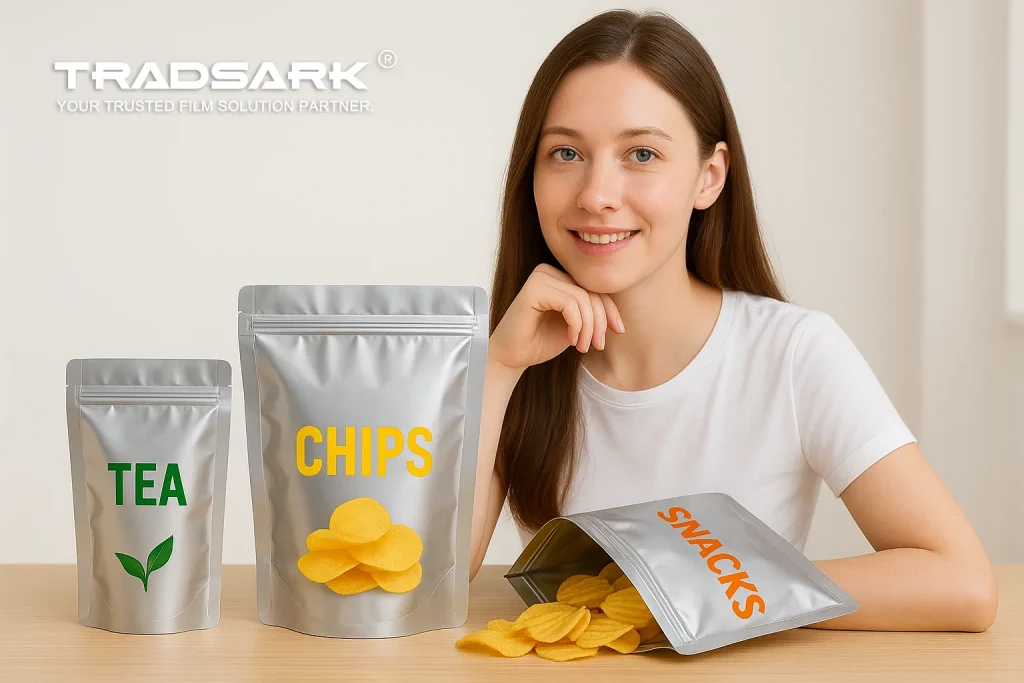
2.1 Snack Food Packaging: Lightweight, Barrier Performance, and Shelf-Life Extension
Snack food—including chips, nuts, candies, and puffed products—is currently the largest application segment, accounting for more than 35% of total food packaging demand for PET metallized films.
Snack products require packaging with:
- High oxygen barrier
- Low water-vapor transmission rate
- Oil resistance
- Strong shelf-life performance
- Eye-catching appearance
Typical material structures include 12μm PET metallized film laminated with CPP or PE, forming multi-layer composite films.
Key advantages:
- Oxygen transmission rate (OTR): 1–3 cm³/(m²·24h·atm)
- Water vapor transmission rate (WVTR): ≤2 g/(m²·24h)
- Shelf-life can be extended from 3 months to over 12 months
- Weight reduced by 30% compared with aluminum foil laminates
- Transport and logistics cost reduced by 15–20%
The metal gloss of the aluminum layer enhances product appearance, and PET’s printing adaptability supports high-resolution designs and holographic anti-counterfeiting. As a result, demand for holographic PET metallized film in snack packaging is increasing at an annual rate of 18%.
2.2 Dairy Product Packaging: Protecting Nutrients and Ensuring Safety
Dairy products such as liquid milk, yogurt, cheese, and milk powder are highly sensitive to oxygen, UV light, and moisture. PET metallized film provides excellent protection and extends product shelf-life.
Application scenarios:
- Aseptic packaging
- Roof-top carton inner layers
- Milk powder can liners
High-barrier metallized PET (aluminum thickness ≥40 nm) offers:
- Strong UV shielding
- Low OTR & WVTR
- Shelf-life extension of UHT milk to 6–12 months
- Yogurt shelf-life extended from 7 days to 30 days
In the milk powder sector, PET metallized film laminated with aluminum foil ensures moisture resistance, prevents caking, and maintains nutritional stability. By 2025, the dairy packaging segment is expected to grow at 9.7%, with high-barrier PET films accounting for over 41.6% of demand.
2.3 Ready-to-Eat and Prepared Food Packaging: Freshness and Convenience
Ready-to-eat products—including instant rice, soups, cooked meats, and pre-made meals—require packaging materials that can withstand high temperatures, maintain freshness, and offer convenience.
PET metallized film provides:
- Excellent retort and steam-sterilization resistance (up to 121°C)
- High mechanical strength
- Long shelf-life stability
- Microwave-safe properties (depending on structure)
Typical structure for ready-meal packaging:
- PET metallized film + PA + CPP
After high-temperature sterilization, barrier performance remains stable, enabling a shelf-life of 6–12 months. The market for ready-to-eat foods grew significantly in 2024, with PET metallized film usage increasing by 15%, making it one of the fastest-growing segments.
2.4 Coffee and Tea Packaging: Aroma Preservation and Moisture Protection
Coffee and tea are highly sensitive to oxygen, moisture, and aroma loss. PET metallized film is widely used in:
- Coffee bean bags
- Drip coffee filters
- Tea bags
- Coffee capsule lidding films
Advantages:
- Strong aroma preservation
- Long-term freshness retention
- Moisture-proof and light-blocking
- Excellent seal strength and laser scoring capability
PET metallized packaging can extend coffee bean shelf-life from 1 month to 6 months, and green tea shelf-life up to 18 months. In coffee capsules, precise metallization (thickness tolerance ≤±1.5 nm) ensures reliable sealing under pressure.
Water-based metallization technology is becoming increasingly important. Its share increased from 15% in 2020 to 28% in 2023, and is expected to exceed 40% by 2025.
2.5 Frozen Food Packaging: Durability Under Extreme Conditions
Frozen foods such as dumplings, seafood, and meat require packaging materials that can withstand extremely low temperatures without cracking.
PET metallized film provides:
- Excellent low-temperature resistance (down to –40°C)
- Maintained tensile strength and flexibility
- Strong barrier against freezer burn and moisture loss
- Extended shelf-life to 12–24 months
In regions with strong cold-chain logistics such as East China, consumption of PET metallized film for frozen food packaging accounts for over 55% of national demand.
3. Technical Advantages of PET Metallized Film
3.1 Outstanding Barrier Properties
The aluminum layer significantly enhances the oxygen, moisture, and UV barrier properties, making metallized PET 100–1000 times better than non-metallized PET. It can replace traditional aluminum foil laminates while maintaining thinness and flexibility.
3.2 High Mechanical Strength
PET base film features:
- Tensile strength ≥200 MPa
- High tear resistance
- Excellent puncture resistance
- Stable performance in high-speed printing and laminating lines
This makes metallized PET ideal for large-scale industrial packaging.
3.3 Environmental Advantages
With advancements in recycling and delamination technologies, PET metallized films can reach 85%+ recycling efficiency. Water-based metallization and solvent-free lamination reduce VOC emissions by up to 60%, supporting global sustainability goals.
3.4 Cost Efficiency
Compared with aluminum foil laminates:
- Material cost is reduced by 20–30%
- Lightweight structure reduces freight cost by 15–20%
This makes PET metallized film a preferred solution for food companies seeking cost reduction and efficiency improvement.
4. Market Landscape of China’s PET Metallized Film Industry
4.1 Production Clusters
China’s PET metallized film manufacturing is concentrated in:
- East China (Jiangsu, Zhejiang, Shanghai)
- South China (Guangdong, Fujian)
Jiangsu, Zhejiang, and Guangdong account for over 68% of total production capacity.
4.2 Industry Concentration
The industry is moving toward consolidation. The top five manufacturers hold nearly 45% of the market share. Product structure is shifting from general-purpose films to:
- High-barrier metallized PET
- Retort-grade metallized PET
- Eco-friendly water-based metallized PET
By 2025, high-barrier products are expected to reach 41.6% of market share.
4.3 Regional Demand Trends
- East China: 55% of total consumption (largest food-processing hub)
- Central & Western China: fastest growth due to industrial transfer
5. Future Trends of PET Metallized Film in the Food Packaging Industry
5.1 Environmental Transformation: Recyclability and Bio-Based PET
Future development will focus on:
- Bio-based PET metallized films
- Recyclable single-material structures (PET/PE, PET/PET)
- Aluminum-detachable metallized films
- Water-based and solvent-free coating technologies
These will align with global sustainability policies.
5.2 High-Barrier and Functional Films
Demand will increase for:
- Ultra-high barrier PET
- Retort-able metallized films
- Anti-static, easy-tear, matte, and holographic metallized films
- Microwave-safe high-temperature packaging
Functional differentiation will become a major competitive advantage.
5.3 Smart Packaging Integration
PET metallized film will integrate more features:
- Laser holograms
- QR codes for traceability
- Digital anti-counterfeiting technology
- Intelligent freshness indicators
6. Conclusion
PET metallized film has become an essential material in the food packaging industry due to its outstanding barrier performance, mechanical strength, printability, cost advantages, and environmental potential. While snack foods, dairy products, ready-to-eat meals, coffee/tea, and frozen foods remain its largest application sectors, the material is rapidly evolving toward high-barrier, eco-friendly, and intelligent packaging.
With strict global sustainability policies and rising consumer expectations, the PET metallized film market will continue to expand, with China remaining one of the most important production and consumption centers worldwide.
