
Reviewed by: Tradsark Agricultural Films Team
Last updated: March 2026
Scope: Practical orchard use of reflective mylar film, reflective ground cover, and polyester-based agricultural reflective film for apples, grapes, cherries, and other high-value fruit crops.
Fruit color is not only a visual trait. In commercial orchards, it is often a pricing factor. For many apple, cherry, and grape growers, stronger color development can influence pack-out, grade, harvest timing, and final returns. That is why more orchard managers are evaluating mylar reflective film, reflective mylar film, reflective ground cover, and other forms of agricultural reflective film as part of a broader fruit-quality strategy.
In online searches, buyers use many overlapping terms, including Mylar Polyester Film, reflective mylar sheet, reflective mylar film roll, reflective mylar for plants, reflective mylar sheets, reflective mylar roll, Plant Reflective Film, Silver Plant Reflective Film, aluminized mylar, and reflective ground cover. In real orchard practice, however, the key question is not the name alone. The real question is whether the material can improve light distribution inside the canopy, survive field conditions, and support more marketable fruit in a cost-effective way.
In grower markets, “mylar reflective film” is widely used as a search term for reflective polyester film products. In practical orchard use, what matters most is not the label itself, but whether the film offers useful reflectivity, outdoor durability, field handling convenience, and a realistic service life under working orchard conditions.
Why Orchard Light Distribution Matters So Much
Many orchard problems that appear to be “color problems” are actually light-distribution problems. In modern planting systems, the upper and outer canopy often receives the strongest sunlight, while fruit in the lower or inner canopy remains shaded for much of the day. This uneven exposure can reduce red color development, delay maturity uniformity, and lower the percentage of fruit that meets premium fresh-market standards.
Penn State Extension notes that red color development in apples is influenced by genetics, environmental conditions, crop load, nutrition, stress, and other management factors. In other words, fruit color is not controlled by one input alone. However, light exposure remains one of the most important practical levers growers can manage.
For that reason, reflective mylar film, reflective mylar sheet, and reflective mylar for plants have become useful tools in orchards where fruit appearance strongly affects value. Instead of relying only on overhead sunlight, the orchard floor becomes an active reflective surface that returns usable light into shaded fruiting zones.
What Is Mylar Reflective Film in Orchard Use?
In grower language, mylar reflective film usually refers to a reflective polyester-based film, often metallized, used to redirect light back into the canopy. In orchard use, the most important issue is not whether the product is called mylar, reflective polyester film, or reflective PET film. What matters is whether it performs well outdoors and reflects useful light consistently.
A practical orchard-grade reflective mylar film roll or reflective mylar sheet should be evaluated on several real performance points:
- visible light reflectivity
- strength and tear resistance
- outdoor weather stability
- handling and rolling convenience
- resistance to dirt, wrinkling, and field damage
- ease of installation and storage
- usable service life across one or more seasons
This is where many buyers make mistakes. Two films may look similar online, yet behave very differently in the field. A low-cost reflective mylar roll may look attractive in a product image, but become difficult to anchor, easy to tear, or less reflective after repeated orchard use. By contrast, a stronger Mylar Polyester Film-type structure or orchard-grade reflective polyester composite may cost more initially but perform better over time.
At Tradsark, we generally recommend that growers compare orchard reflective film by usable field life, reflectivity retention, and handling efficiency, not by headline price alone.
How Reflective Ground Cover Works in Orchards
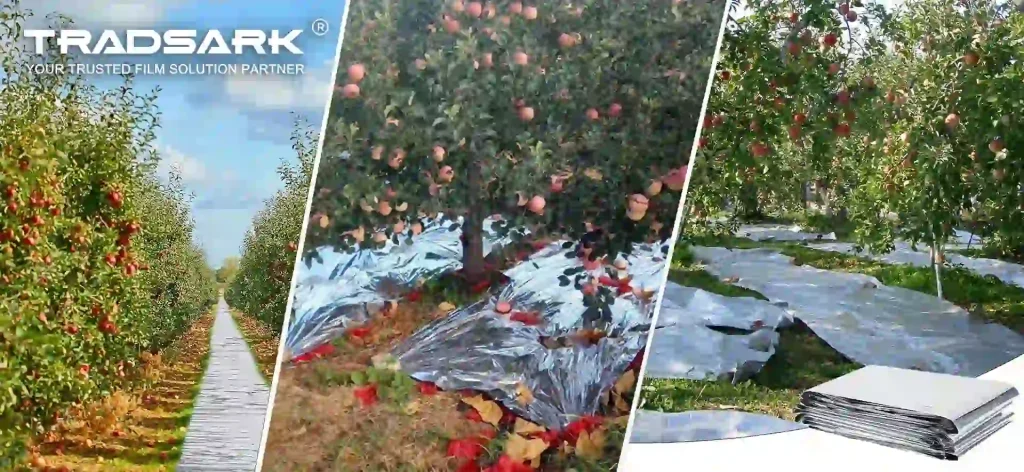
The basic principle is simple. Sunlight strikes the reflective surface on the orchard floor and bounces upward into the lower and inner canopy. Fruit that would otherwise receive limited light may receive more reflected light during the period when color development matters most.
Washington State University Tree Fruit explains that growers use reflective film materials on orchard floors to reflect sunlight back up into the trees to improve color on apples, cherries, and other stone fruit. That point is important because it confirms that orchard-floor reflectivity is not just a theory. It is already part of practical fruit production systems in commercial tree-fruit regions.
This does not mean every reflective mylar for plants product delivers identical results. Different films reflect light differently, and different orchard systems respond differently. But the general logic is clear: more useful reflected light in the right period can improve color development in fruit that would otherwise remain too shaded.
Why Growers Use Agricultural Reflective Film
The commercial value of agricultural reflective film is usually not about increasing tonnage alone. In many orchards, the bigger advantage is improving fruit color, pack-out quality, and premium-grade percentage.
Cornell Cooperative Extension reported that reflective ground cover for apple coloring may increase Extra Fancy grade, improve first-pick quality, and is commonly installed about 10 days to 3 weeks before harvest for harvest-color effects. Cornell’s field materials also note that different cover materials vary in expected life, handling, and cost assumptions, which is important when growers compare white fabric, metallic film, and other reflective options.
That is why growers searching for Plant Reflective Film, Silver Plant Reflective Film, reflective mylar sheets, or reflective ground cover are often not really buying “film.” They are buying a possible improvement in light management, fruit finish, and marketable quality.
This is especially relevant in orchards where:
- color grade affects price strongly
- fruit in the lower canopy is often downgraded
- harvest may require multiple picks
- export or premium retail channels demand strong visual consistency
In those cases, a better reflective mylar film roll can become part of a larger quality-control strategy.
Reflective Film Works Best in Managed Orchards, Not as a Shortcut
One of the most important truths to explain honestly is this: reflective mylar film is useful, but it is not magic.
Fruit color is affected by multiple factors, including genetics, crop load, nutrition, stress, light exposure, and seasonal conditions. Reflective film can improve the orchard light environment, but it cannot fully compensate for poor pruning, overloaded trees, weak canopy management, delayed leaf removal, or inappropriate harvest timing.
That is why the most realistic orchard message is this:
- reflective film can help
- canopy structure still matters
- timing still matters
- orchard floor condition still matters
- variety and local climate still matter
That is also one reason this type of content tends to be more trustworthy for both growers and search engines: it explains both the benefits and the limits.
Apples: The Strongest and Best-Supported Use Case
Among all orchard crops, apples are the strongest and best-documented use case for reflective mylar film and reflective ground cover.
In many apple systems, the goal is not merely “more red.” The goal is:
- more consistent red blush
- better coloration on shaded fruit
- better lower-canopy finish
- improved first-pick quality
- stronger premium-grade share
- better harvest flexibility before late-season weather risk
That makes mylar reflective film not just a visual accessory, but a crop-value tool when used correctly. In fresh-market apple blocks, even a relatively small shift in premium fruit percentage can have a meaningful commercial effect.
Cherries and Other Tree Fruit
Cherries are another important category where reflective ground cover can make practical sense. In cherries, the market penalty for uneven color can be severe. Fruit may size well but still fail to achieve the visual uniformity buyers expect. In those cases, returning more light into the fruiting zone can help reduce the difference between the sun-exposed and shaded side of the fruit.
Even here, however, reflective film is most useful when the orchard already has reasonable canopy openness and decent floor conditions. A rough, muddy, or weed-heavy orchard floor will reduce the practical efficiency of even a high-quality reflective mylar film roll.
Grapes: A Useful but More Conditional Case
Grape growers also search for reflective mylar for plants, Plant Reflective Film, and agricultural reflective film, especially when fruit color and bunch uniformity matter. Here, the most responsible way to write is to stay close to what extension and canopy-management literature supports.
University of Georgia Extension explains that excessive shading of grape clusters reduces color development and fruit quality, while fruit-zone management improves airflow and light exposure to clusters. That means the basic physiological logic is clear: shaded fruit zones are a quality problem, and improving cluster-zone light can be beneficial.
For that reason, some growers evaluate reflective mylar film, reflective mylar sheets, or other reflective ground materials as part of a broader vineyard light-management approach. In practical terms, this is most relevant where:
- bunch color is commercially important
- vine vigor leads to heavy fruit-zone shading
- the floor can be kept relatively clean and dry
- the grower already uses good canopy and disease management
That said, grapes are not the same as apples. The strongest direct commercial evidence for reflective groundcover remains in apples. So in vineyards, reflective film should usually be presented as a promising management aid rather than a guaranteed color solution.
Choosing Between Reflective Mylar Film, Aluminized Mylar, and Other Reflective Materials
When buyers search for reflective mylar, aluminized mylar, reflective mylar sheet, or reflective mylar film roll, they often assume these are interchangeable. In the field, they are not.
A grower should compare reflective orchard materials on practical criteria such as:
1. Reflectivity and Light Quality
A useful orchard film should reflect strong visible light back into the canopy. In real field use, usable reflectivity matters more than a glossy sales description.
2. Tear Resistance
A weak reflective mylar sheet that tears during installation, wind events, or equipment movement will quickly lose value.
3. Handling and Re-Rolling
A commercial orchard may need to deploy, remove, clean, roll, and store reflective film efficiently. A material that is technically reflective but difficult to handle may increase labor cost.
4. Weather Stability
Outdoor use means exposure to dew, dust, irrigation splash, wind, and sunlight. A serious Silver Plant Reflective Film should remain functional under field conditions, not just in indoor or packaging applications.
5. Cost per Useful Season
The cheapest film per roll is not always the lowest-cost orchard solution. Growers should compare price on a per-season, per-useful-acre basis, not just on a per-roll basis.
When to Install Reflective Mylar Film
Timing is one of the most important variables in orchard performance.
In apples, reflective film is often most relevant during the maturation and final color-development period. For harvest-color effects, many growers focus on installation in the final days or weeks before harvest rather than laying the film too early and exposing it to unnecessary wear, dirt, and handling damage.
A realistic orchard rule is this: install reflective material early enough to influence the key color-development phase, but not so early that you create avoidable labor, contamination, and durability problems.
Orchard Floor Preparation Before Installation
Even a premium reflective mylar film roll can underperform if the orchard floor is poorly prepared.
Before deployment, the row or alley area should ideally be:
- free of sharp sticks, stones, and debris
- reasonably level
- not heavily covered in weeds
- not excessively muddy
- suitable for anchoring or weighting
A dirty or unstable orchard floor reduces the usable effect of reflective ground cover. Mud, fallen fruit, leaves, and dust all cut reflectivity. In other words, orchard reflective film is only as good as the reflective surface that remains visible during the period when fruit needs it most.
Best Installation Practices
To get meaningful performance from reflective mylar sheets or reflective mylar roll products, installation quality matters almost as much as the film itself.
A few basic field principles are important:
- The film should be laid flat enough to present a broad reflective surface, but not stretched so tightly that it tears easily.
- Edges should be anchored securely, because wind damage is one of the fastest ways to ruin usable life.
- The reflective surface should be placed where it can actually return light into the target canopy zone.
- The film should be checked regularly during the deployment period for dirt, pooling water, or damage.
- The orchard crew should have a clear workflow for deployment, inspection, and removal.
These are not glamorous points, but they determine whether a reflective mylar film program works smoothly or becomes a labor problem.
Canopy Management Still Determines the Ceiling
No matter how good the Plant Reflective Film is, a fully closed canopy will still block light. Reflective film raises the light available from below, but it does not eliminate the need for canopy structure.
That is why reflective film should be seen as a complement to pruning, crop load balance, shoot control, leaf removal where appropriate, and harvest timing. A better and more honest statement is this:
Reflective orchard film improves the light environment. Orchard management determines how much of that improved light can be translated into marketable fruit quality.
Storage, Reuse, and Long-Term Value
A strong reflective mylar film roll may justify itself through reuse, but only if the grower handles it properly.
After the season, the film should be:
- cleaned to remove dirt and organic residue
- dried before storage
- rolled rather than crushed
- stored away from sharp equipment and standing moisture
- protected from unnecessary off-season UV exposure
This sounds basic, but it directly affects cost per season. A grower who buys a stronger reflective mylar sheet but stores it badly may lose the economic advantage.
For growers evaluating orchard options, Tradsark generally suggests matching film width, roll format, and durability to row spacing, orchard workflow, and target harvest window rather than choosing only by initial material cost.
Common Mistakes Buyers Make
Many reflective-film purchasing mistakes are predictable.
- Buying a product that was designed for packaging, decorative, or indoor uses and expecting it to perform like orchard-grade agricultural reflective film.
- Selecting an extremely thin or weak reflective mylar sheet because the quoted price looks attractive.
- Installing the film in orchards with very dense canopies and then blaming the material for limited results.
- Leaving the surface dirty and expecting it to continue performing as a bright Silver Plant Reflective Film.
- Writing unrealistic ROI assumptions without considering orchard variety, climate, quality targets, and handling cost.
Growers who avoid these mistakes usually treat reflective film as part of a field system, not as a simple commodity.
Is Reflective Ground Cover Worth It?
The answer depends on crop value, orchard condition, and how color influences your selling price.
In premium apples, the answer may often be yes. In cherries, it can make sense where color uniformity is commercially decisive. In grapes, it may be useful in selected systems as part of broader fruit-zone light management. In low-value orchards or poorly managed blocks, the answer may be weaker.
That is a much more realistic way to evaluate reflective mylar film, reflective ground cover, and agricultural reflective film.
Conclusion: Reflective Mylar Film Is Most Valuable When It Is Part of a System
Search demand for terms like mylar reflective film, reflective mylar film, reflective mylar sheet, reflective mylar film roll, reflective mylar for plants, reflective mylar, reflective mylar roll, aluminized mylar, reflective mylar sheets, Plant Reflective Film, Silver Plant Reflective Film, Mylar Polyester Film, agricultural reflective film, and reflective ground cover continues because growers are looking for practical ways to improve fruit quality.
The strongest evidence today supports orchard-floor reflective materials as a useful tool in apple color management, with practical relevance in cherries and selected use cases in vineyards as part of wider light-management programs. The most trustworthy way to describe these materials is not as miracle products, but as field tools that can improve canopy light distribution when matched with proper crop management.
Actual results will vary by cultivar, canopy density, orchard floor condition, climate, timing of installation, and overall canopy management. But in orchards where fruit color strongly affects selling price, a well-chosen reflective mylar film roll or other orchard-grade reflective ground cover can become a real quality and profitability lever.
FAQ: Reflective Mylar Film for Orchards
What is the difference between mylar reflective film and ordinary reflective plastic film?
In orchard use, mylar reflective film is often used as a market term for reflective polyester-based film. Ordinary reflective plastic may be cheaper, but orchard performance depends on durability, field handling, and useful reflectivity over time, not appearance alone.
Is reflective mylar for plants suitable for apples?
Yes, apples are the strongest and best-supported orchard use case. Reflective groundcovers can improve the orchard light environment and support red fruit coloration in apples under commercial conditions.
Can reflective mylar sheets help grapes?
They may help in selected vineyards as part of a wider light-management strategy, but the strongest direct commercial evidence remains in apples. In grapes, the safest conclusion is that reducing fruit-zone shading improves color and quality, and reflective materials may be one way to support that in some systems.
When should reflective mylar film roll be installed?
In apples, reflective material is often installed close to harvest during the main color-development period, rather than across the entire season.
Does reflective ground cover always increase yield?
Not necessarily. In many orchards, the main commercial value is improved color, pack-out, and premium-grade percentage rather than a simple increase in total yield.
Is aluminized mylar always better than other reflective materials?
Not always. Material choice should be based on orchard conditions, durability needs, light performance, handling, and cost per useful season rather than material name alone.
What should buyers look for in agricultural reflective film?
Growers should compare reflectivity, tear resistance, weather stability, roll format, installation practicality, storage convenience, and realistic field life. For serious orchard use, those factors matter more than glossy marketing descriptions.
