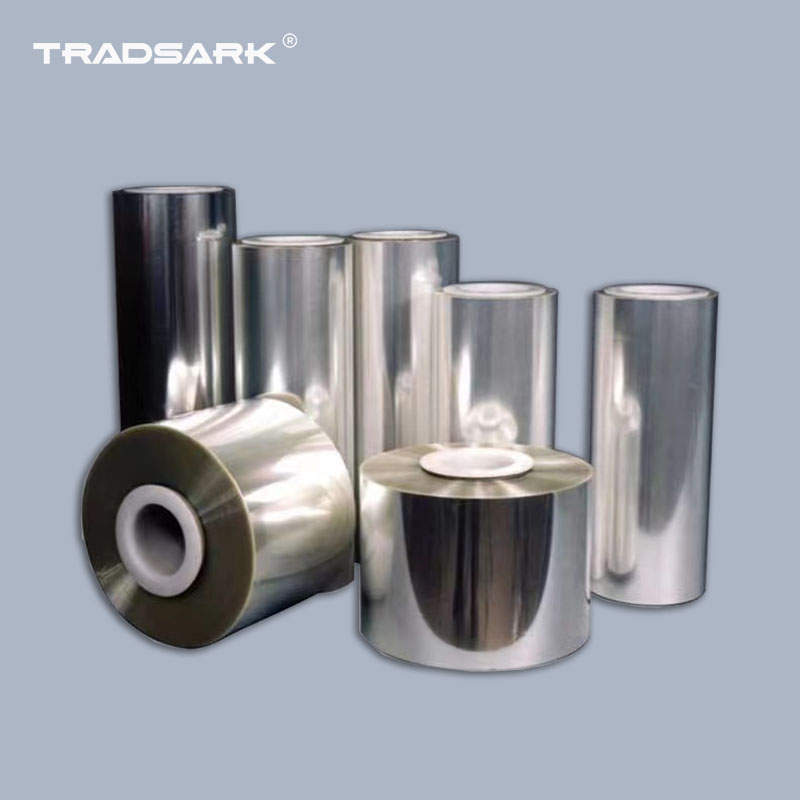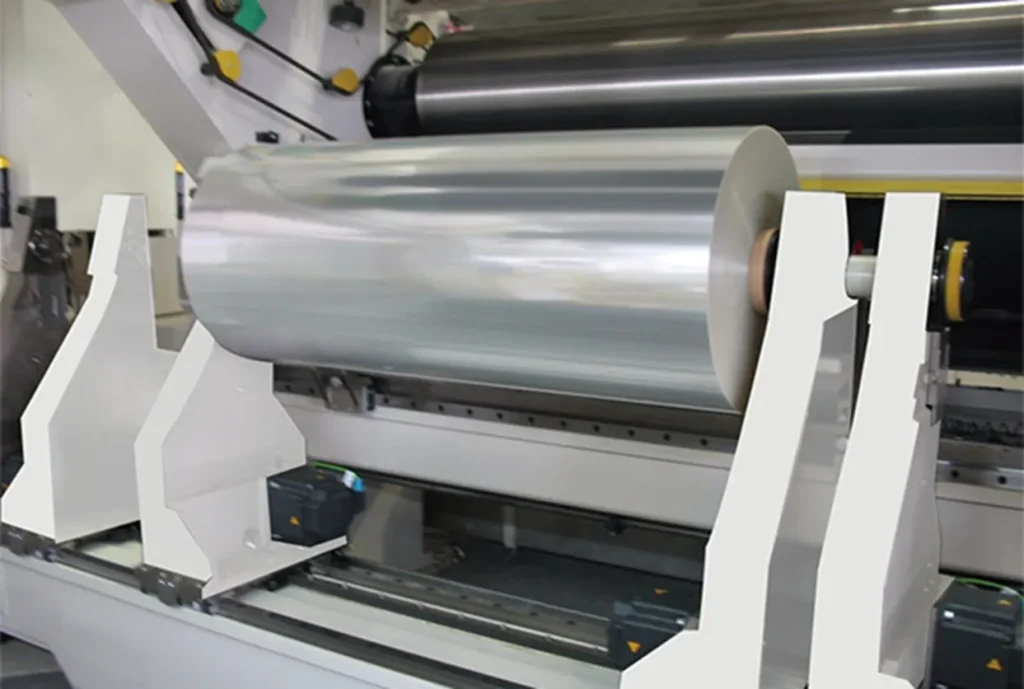
Cast polypropylene film and its vacuum-metallized sibling are usually discussed as two line items in a converter’s material catalogue. That framing misses the more useful way to understand them. CPP is the platform: a soft, sealable, isotropic web that does the physical work of closing a package and surviving the line. VMCPP is what that platform becomes when a converter needs the same web to also carry barrier and light protection without adding a separate ply. The two are not competing products so much as two configurations of the same polypropylene foundation—one optimized for seal integrity and conformability, the other for functional consolidation.
The market numbers reflect that division of labour. The global coextruded CPP film market was valued at roughly US$ 6.5 billion in 2025, with a projected CAGR of around 3.2% through 2032. The metallized CPP segment is smaller in absolute terms—approximately US$ 1.7 billion in 2025—but is advancing at a markedly faster 6.8% CAGR, projected to reach close to US$ 2.7 billion by 2032. That growth-rate gap is the story: the base CPP market is expanding with the broader flexible packaging industry, while the metallized variant is gaining share within it by replacing heavier, harder-to-recycle barrier layers in a specific and expanding set of applications.
CPP as the Platform: What the Cast Web Brings That Oriented PP Cannot
CPP is produced by casting molten polypropylene onto a chill roll rather than stretching it after solidification. The consequence is a film with little deliberate molecular orientation: softer than BOPP, more isotropic in its mechanical behaviour, and—critically—heat-sealable without the specialty coatings that BOPP requires to form a reliable seal. That native sealability is the property that anchors CPP’s role in laminate structures. Whether the package is a snack bag, a retort pouch, or a medical sterilization pack, CPP is typically the layer that faces the product and closes the pack.
The performance profile that follows from the cast process is well suited to that job. CPP offers higher elongation and better conformability than BOPP, which helps it flow around product contours and absorb line stresses without fracturing. Its tear and impact resistance are generally higher than BOPP’s, and its low-temperature toughness makes it a practical choice for frozen-food formats and other cold-chain applications where a stiffer oriented film might become brittle. It also brings a softer hand feel, high transparency, and a low specific gravity of around 0.91 g/cm³, which translates into more square meters per kilogram than denser substrates.
The trade-off is structural. Because CPP is not oriented, it cannot match BOPP in stiffness or dead-fold behaviour, and its barrier properties in clear form are lower than BOPP’s. That is precisely why the metallized variant exists: it adds the barrier function that clear CPP lacks, without giving up the sealability and toughness that make CPP useful in the first place.
VMCPP: A Barrier Layer and a Sealant in the Same Ply
Vacuum metallized CPP is made by depositing a layer of aluminum—measured in tens of nanometers—onto a treated CPP base film under high vacuum. The base film is typically a three-layer co-extrusion with a heat-sealable surface, a structural core, and a metallization-ready face that has been corona- or plasma-treated to raise surface energy and anchor the aluminum. The result is a film that behaves like CPP on the seal side and like a barrier web on the metal side.
The barrier contribution is meaningful in the right context. Representative high-barrier VMCPP grades publish water vapor transmission rates in the 0.2–0.5 g/m²/day range at 38–40°C/90% RH and oxygen transmission rates in the 10–15 cc/m²/day band, at optical densities around 1.9–2.0. Those are not foil numbers in every metric, but they are a step change relative to clear CPP, and they arrive in a web that also heat-seals. In a two-layer PET//VMCPP or OPP//VMCPP structure, the VMCPP ply functions as both the inner sealant and the primary moisture and light barrier—a consolidation that reduces total laminate complexity and, in some formats, eliminates a separate barrier ply altogether.
The property that decides whether VMCPP performs as specified is not optical density alone but aluminum adhesion. Polypropylene has low intrinsic surface energy, and the metal layer will only survive slitting, lamination, and pouch forming if it is properly anchored. Surface tension on the metallized face is commonly specified at ≥36 mN/m, and the industry increasingly uses in-line plasma treatment before deposition to manage surface-energy decay during storage. A VMCPP that meets its WVTR target on a datasheet but fails a tape-peel adhesion test after lamination is not a cheaper alternative; it is a different, lower-functioning material that will show up later as leaker rates and shelf-life failures.
Where the Two Films Divide the Work in Practice
Clear CPP and VMCPP occupy overlapping but distinguishable application territories, and the boundary between them is defined by the barrier requirement of the product rather than by a preference for one film type over the other.
Clear CPP is the default where seal integrity, conformability, and product visibility matter more than extended barrier. It is the inner layer in BOPP//CPP snack and bakery laminates, the sealant web in retort pouches before metallization enters the picture, and the material of choice for medical and pharmaceutical formats where transparency and sterilization compatibility are required. Retort-grade CPP is its own technical tier, engineered to withstand 121–135°C sterilization without delamination or seal failure, and this is one of the faster-growing pockets within the CPP market: retort, medical, and lidding applications are cited as growing above 4% annually against roughly 3% for the broader European CPP market.
VMCPP enters where the package needs moisture and light protection that clear CPP cannot deliver, but does not justify the weight, cost, or recycling penalty of aluminum foil. Biscuits, crackers, confectionery, dried foods, and instant noodles are the reference volume applications: the metallized layer protects crispness and flavour, the CPP side seals at low initiation temperatures, and the combined web runs on vertical form-fill-seal lines at production speeds without the metal layer cracking or delaminating. Beyond dry goods, VMCPP is used in cosmetic sachets, pharmaceutical blister lidding, and other formats where metallic appearance and moderate barrier are part of the specification.
The dividing line is not absolute. A converter may specify clear CPP for a retort pouch that will receive its barrier from an outer foil or high-barrier PET ply, and specify VMCPP for a dry-goods pack that needs an integrated barrier-sealant layer. The choice turns on where the barrier function sits in the structure and whether consolidating it into the sealant layer simplifies the laminate enough to justify the switch.
The Sustainability Variable: VMCPP’s Strategic Role in Mono-PP Structures
The regulatory environment in Europe has made the CPP–VMCPP distinction more consequential than it was a decade ago. The EU Packaging and Packaging Waste Regulation has established recyclability requirements that multi-material laminates containing aluminum foil will struggle to meet, and from 2030 packaging below a specified recyclability threshold may not be placed on the market. That has pushed brand owners and converters toward polypropylene-dominant structures in which every functional layer is PP-based or PP-compatible.
VMCPP is central to that redesign because it allows a PP mono-material structure to carry barrier performance that would otherwise require a foil or VMPET ply. Suppliers have commercialized vacuum-metallized high-barrier PP films explicitly positioned for this transition, reporting substantially improved barrier performance over conventional mono-material packaging and meaningful lifecycle CO2 reductions relative to aluminum foil. European converters have expanded CPP capacity specifically to serve recyclable mono-material solutions ahead of PPWR and extended producer responsibility requirements, citing CPP’s recyclability and suitability for mono-material packaging as the rationale. The European recyclable CPP segment is expected to be among the fastest-growing categories within the region’s CPP market as recycling infrastructure matures.
The honest formulation of VMCPP’s sustainability case is substitution and simplification, not an unqualified recyclability claim. The metallized layer is extremely thin relative to a foil ply, and the structure is PP-dominant, which makes it a more credible candidate for mechanical recycling within a PP stream than the foil-containing laminate it displaces. But the recyclability of the finished pack still depends on the full composition, the adhesives and coatings used, and the receiving facility’s acceptance criteria. The defensible position is that VMCPP enables a PP mono-material or PP-dominant design that was not achievable with a foil barrier—not that the presence of metallization alone makes a package recyclable.
Why Grade Diversity Makes Custom Production the Practical Default
One conclusion follows from everything above: “CPP” and “VMCPP” are not single products but families of films whose performance is set by a long list of adjustable parameters. Base-film thickness, layer count and layer ratio, seal-initiation temperature, coefficient of friction on the non-seal side, surface tension on the metallized face, optical density of the aluminum deposition, metal adhesion after lamination, and retort resistance are all specification variables, and different applications pull them in different directions. A 20 μm low-SIT metallized grade for high-speed confectionery wrapping and a 70 μm retort-grade clear CPP for a ready-meal pouch share a polymer family but not a performance envelope.
That diversity is why standard catalogue grades only cover part of the demand. A converter running a high-speed VFFS line may need a COF and seal-initiation profile that no general-purpose grade offers; a brand owner moving a pack from a foil laminate to a mono-PP structure may need a high-barrier metallized grade with adhesion performance tuned to a specific laminating adhesive; a medical packager may need documented sterilization compatibility and traceability that off-the-shelf film cannot supply. In each case the film has to be engineered against the application, the converting process, and the end-of-life requirement simultaneously.
This is the point at which supplier capability becomes part of the specification. Producers with in-house casting, co-extrusion, metallization, and slitting can adjust layer architecture, treatment levels, and deposition parameters to match a customer’s line and product rather than asking the customer to adapt to a fixed grade. Custom production in this context is not a marketing add-on; it is the mechanism by which the technical distinctions described in this article are translated into a film that actually runs on a given line and protects a given product. Converters and brand owners evaluating CPP and VMCPP suppliers are increasingly asking not only what grades a producer lists, but how far those grades can be adjusted—and how quickly—to meet a specific application requirement.
Custom CPP Film Manufacturing: Factory-Direct Supply to Your Specification
We are a CPP film factory, not a trading company. Our production covers the full cast polypropylene range discussed above—clear CPP, retort-grade CPP, low-temperature heat-sealable CPP, and vacuum metallized CPP (VMCPP)—and we manufacture to customer requirements rather than to a fixed catalogue alone. Thickness, width, layer structure, seal-initiation temperature, coefficient of friction, corona or plasma treatment level, aluminum optical density, metal adhesion performance, core size, and roll length can all be adjusted to match your converting line and end application.
For converters, brand owners, and distributors sourcing CPP and VMCPP films, this means you can specify the performance you need and have it produced at factory level, with the consistency and traceability that come from in-house casting, co-extrusion, metallization, and slitting under one roof. Whether you need a standard grade supplied reliably at volume or a custom specification developed for a new mono-PP packaging project, we can produce various specifications of CPP film according to your requirements. Send us your target thickness, width, barrier and seal requirements, and application details, and we will recommend and produce the grade that fits.
Clear CPP and VMCPP are two outputs of the same cast polypropylene platform, and the industry’s shift toward mono-material, recyclable packaging is making both more important: CPP as the sealable foundation of the PP structure, and VMCPP as the layer that lets that structure carry barrier performance without reaching for aluminum foil. Matching either to a real packaging problem is a specification exercise—and as a factory, we are set up to manufacture to that specification.