
Industry Positioning and Core Characteristics: The Strategic Value of Functional Films
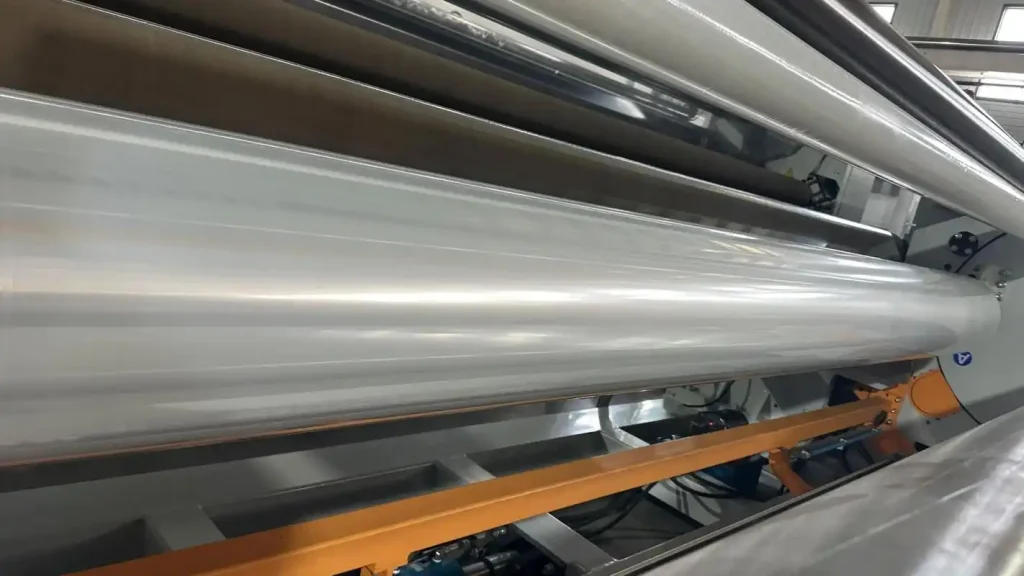
Metallized PET Film, also known as Aluminized Polyester Film, is a high-performance composite material produced by depositing an ultra-thin aluminum layer (typically 3–50 nm) onto PET base film through Physical Vapor Deposition (PVD) technology.
This structure combines the mechanical stability of PET with the barrier, conductive, and reflective properties of metal, making it an essential material for modern industrial applications.
Key Performance Advantages of Metallized PET Film
The competitive edge of Metallized PET Film is reflected in three core dimensions:
- Barrier Properties
- Water Vapor Transmission Rate (WVTR): as low as 0.05 g/m²·day
- Oxygen Transmission Rate (OTR): ≤ 0.5 cm³/m²·day·0.1 MPa
- Mechanical & Thermal Performance
- Tensile strength: 150–200 MPa
- Thermal shrinkage at 150°C: < 1.5%
- Electrical Performance
- Surface resistivity: 0.1–10 Ω/sq
These characteristics make Metallized PET Film indispensable in food packaging, electronics,新能源 batteries, photovoltaics, and energy-saving insulation applications.
In China, this industry is officially classified as a strategic emerging sector under the 14th Five-Year Plan for New Materials, playing a crucial role in domestic substitution and supply chain security for high-end manufacturing.
By 2025, China’s effective production capacity of Metallized PET Film has reached 480,000 tons per year, accounting for 36.5% of global capacity, ranking No.1 worldwide in both production and consumption.
Market Size and Growth Drivers: Structural Opportunities from Volume and Value Growth
Global and Chinese Market Size
According to YHResearch (December 2025):
- Global market size (2024): RMB 17.34 billion
- Forecast (2031): RMB 24.31 billion
- CAGR (2025–2031): 5.0%
China remains the core growth engine:
- China market size (2024): RMB 8.64 billion
- 2021–2024 CAGR: 19.7%
- 2025 production: approx. 410,000 tons
- Capacity utilization: around 90%
Looking ahead to 2026, driven by expansion, green packaging regulations, and manufacturing upgrades, China’s demand is expected to grow 12.5% year-on-year, with ultra-thin (≤6 μm) high-barrier Metallized PET Film growing at over 25% annually.
Structural Shift in Demand by Application
China’s demand structure is rapidly transitioning from traditional packaging dominance to new energy-driven growth.
1. New Energy Applications (32%)
The largest consumption segment in 2025, including:
- Lithium battery pouch packaging (21%)
- Photovoltaic reflective backsheet films (11%)
With EV penetration expected to reach 35% of vehicle sales, demand for low-resistance, high-durability Aluminized Polyester Film continues to surge.
2. Food Packaging (28%)
Still a core application, driven by:
- Ready-to-eat meals
- Snack foods
- Vacuum and retort packaging
Standard 12 μm Metallized PET Film improves barrier efficiency by more than 95%, making it a preferred solution for premium food packaging.
3. Electronics & Capacitors (22%)
Used in:
- Capacitor dielectric films
- EMI shielding
- 5G communication equipment
Demand reached 90,200 tons in 2024, growing 15.3% YoY, driven by electronics upgrades.
4. Other Applications (18%)
Including:
- Building insulation films
- Decorative films
- Yarn packaging
- Emerging technologies such as perovskite photovoltaics and solid-state batteries
Industry Chain Overview: From Raw Materials to End Applications
Upstream: Raw Materials and Cost Structure
Key raw materials include:
- PET chips (60–70% of cost)
- China production (2024): 18.9 million tons
- Major suppliers: Hengli, Rongsheng, Yizheng Chemical Fiber
- High-purity aluminum (15–20% of cost)
- ≥99.99% aluminum still partially imported
- Import dependence: approx. 35%
- Equipment & Technology
- High-end vacuum metallizing machines remain dominated by Germany and Japan
- Imported equipment costs 2–3× domestic alternatives
Midstream: Production Landscape and Technology Differentiation
China’s Metallized PET Film industry shows a “top-tier concentration + niche specialization” structure.
- Top 5 producers control over 58% of total capacity
- CR5 exceeds 55%, with rising consolidation
Technology Tiers
- Tier 1: Listed & state-backed enterprises
- ±3 nm coating precision
- Automotive-grade certification
- Gross margin: 28–35%
- Tier 2: Regional leaders
- Focus on packaging and electronics
- Gross margin: 21–25%
- Tier 3: Small producers
- Low-end packaging films
- Facing cost and environmental pressure
Companies like Tradsark New Materials are increasingly positioning themselves in food-grade, high-barrier, and functional Metallized PET Film segments, aligning with global sustainability and performance trends.
Competitive Landscape: Domestic Rise and Global Competition
Domestic Competition
Leading Chinese manufacturers adopt differentiated strategies:
- Scale + Long-term contracts
- High-end specialization
- Technology transfer from aerospace and defense
Meanwhile, agile mid-sized manufacturers focus on:
- Ultra-thin films
- Flexible MOQs
- Fast delivery cycles
International Competition
Multinationals such as Toray and DuPont dominate the high-end capacitor and optical-grade segments in China, with:
- Unit prices: USD 8–12/m²
- Gross margins: >45%
China remains the world’s largest exporter, shipping 127,000 tons in 2024, mainly to Southeast Asia, Europe, and North America, though high-end penetration remains limited.
Technology Evolution: From Scale Expansion to Quality Upgrade
Key Technical Bottlenecks
- Coating precision gap vs Japan (±5–8 nm vs ±2 nm)
- High dependence on imported equipment
- VOC emissions exceeding EU standards in legacy lines
Technology Trends
- Ultra-thin & high-function films (<4 μm)
- Green manufacturing & recyclable Metallized PET Film
- Digitalized smart production lines
Industry R&D intensity reached 3.1% in 2024, with patents increasingly focused on high-barrier coatings and surface treatment technologies.
Policy Support and Industry Standards
China’s policy framework strongly supports the industry through:
- 14th Five-Year New Materials Plan
- Green Packaging Action Plan
- Tax incentives and R&D deductions
Key standards include:
- GB/T 19631 (BOPET Film)
- QB/T 4038 (Packaging Metallized Film)
- Automotive-grade group standards for新能源 applications
Challenges and Risks
Major Challenges
- Raw material price volatility
- Anti-dumping measures in EU and US
- Stricter VOC emission limits
- Shortage of high-end technical talent
Risk Outlook
- Potential overcapacity
- Substitution by alternative barrier materials
- Supply chain disruptions for high-end equipment
Outlook to 2030: Industry Roadmap
Market Forecast
From 2025 to 2030, China’s Metallized PET Film market is expected to grow at a 12.8% CAGR, exceeding RMB 14 billion, with high-end applications accounting for 60%.
Strategic Directions
- Higher coating precision (±2 nm)
- Localization of core equipment
- Expansion into Southeast Asia and Mexico
- Integrated supply chains from PET chips to end-use films
Conclusion
China’s Metallized PET Film / Aluminized Polyester Film industry is entering a decisive transition from capacity-driven growth to quality- and technology-led development. Supported by strong policy backing, technological innovation, and a massive domestic market, China is steadily moving from a global manufacturing hub to a technology-driven leader.
For manufacturers such as Tradsark New Materials, focusing on high-barrier performance, sustainability, and global service capability will be the key to securing long-term competitiveness in the international market.
