
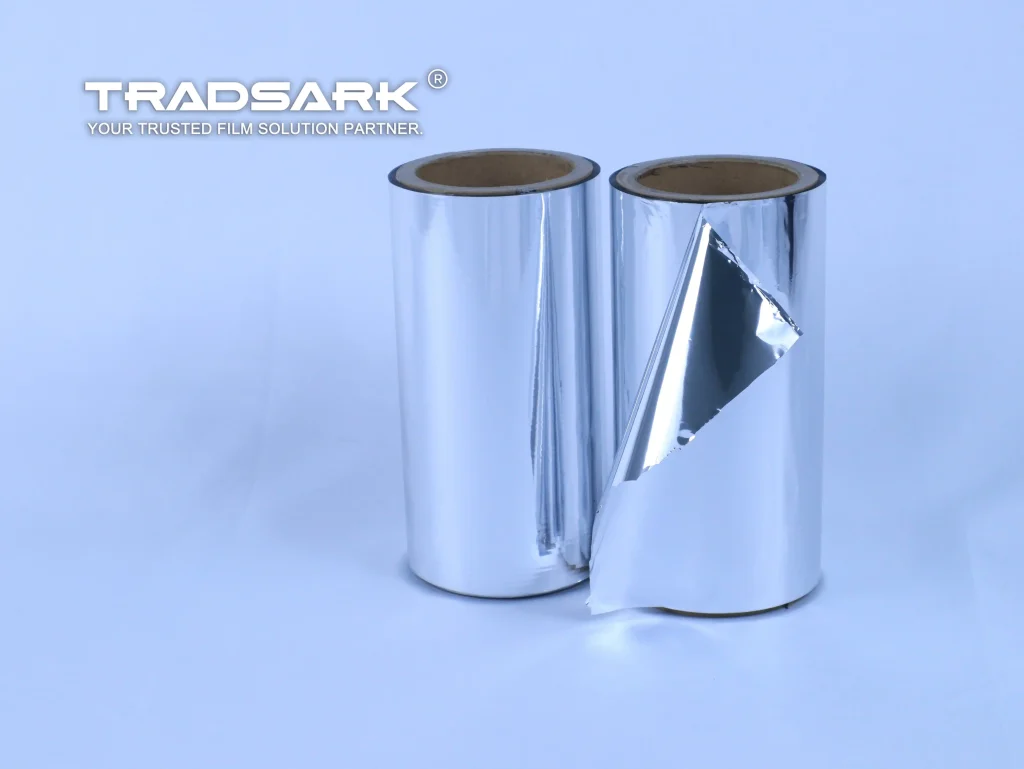
Why metallized film is not a ”commodity”
Metallized film (most commonly vacuum-deposited aluminum on PET/BOPET, BOPP, or CPP, sometimes paired with higher-barrier coatings like PVDC or AlOx) is usually selected for three practical reasons: (1) barrier upgrade, (2) premium metallic appearance, and (3) cost/weight efficiency versus foil laminates. In real converting and packaging production, supplier selection is rarely “lowest price per kg.” The reliable supplier is the one who can repeatedly hit your OTR/WVTR targets, control pinholes and metallizing defects, maintain stable COF and dyne/corona performance, and deliver consistent roll quality across lots.
If you are sourcing for high-speed printing/lamination, the hidden cost is not only material price. It is line stops, scrap, customer complaints, and claim handling triggered by defects like pinholes, scratches, metallizing streaks, weak aluminum adhesion, poor winding, or unstable slip. That is why an ”evidence-based shortlist” is often more useful than a loud ”No.1” marketing claim.
How this Top 10 is ranked
This list is not a sales ranking and not a market-share claim. It is an evidence-weighted RFQ shortlist built from publicly accessible disclosures, with evidence generally weighted in this order:
- Primary evidence (highest credibility): listed-company filings, exchange-hosted PDFs, or regulator/bulletin PDFs that explicitly describe business scope and products (e.g., ”vacuum metallizing,” ”metallized film,” ”metallizing-grade CPP,” etc.).
- Company websites (high usefulness, still “company-stated”): product scope, metallized portfolio (VMPET/VMCPP/VMBOPP), equipment/capacity numbers when stated.
- Industry directories (supporting evidence only): helpful for cross-checking names and categories, but numeric claims are treated as secondary unless corroborated.
Strength map (how buyers actually segment suppliers)
When procurement is done seriously, “metallized film supplier” is not one bucket. Buyers typically segment by production reality:
A) Metallizing-centric, high-barrier specialists
Best for: projects that are ”metallized film first,” with stronger focus on defect control, metallizing consistency, and high-barrier variants (including coated and AlOx options).
B) Large film groups where metallizing sits inside a broader ecosystem
Best for: standardized packaging programs, stable supply, and process alignment across base film + metallizing + converting needs.
C) BOPP/CPP specialists in the decorative, overwrap, and label ecosystem
Best for: appearance-driven programs (high gloss, holographic/anti-counterfeit), and web-handling stability in overwrap/label uses.
D) Export-oriented, multi-product film manufacturers
Best for: mid-volume custom orders, faster response cycles, and consolidated sourcing (transparent films + metallized films + functional reflective/insulation films).
What a ”production-ready” RFQ should include (to avoid under- or over-spec)
Even when you buy ”standard VMPET” or ”VMBOPP,” performance is determined by your converting structure and conditions. A good RFQ is short, but specific:
- End use & structure: what the film is in the laminate (outer/metallized layer/sealant), and the target application (snack, biscuit, tobacco overwrap, pharma, etc.).
- Barrier targets: required OTR/WVTR at stated conditions, and whether you need light/UV shielding.
- Converting requirements: printing method, adhesive type, lamination speed, and if you need high dyne retention or special COF range.
- Heat seal needs (if applicable): hot tack, seal initiation temperature, and whether you need low-temp heat seal.
- Roll specs: width, length, core ID (3″/6″), max OD, splice limits, winding hardness, and allowable edge damage.
- Compliance & documentation: food-contact compliance for your destination market, test reports, and traceability requirements.
A supplier that answers these clearly (and supports with test data) is usually more valuable than one that only quotes a low price.
Top 10 Manufacturers (Evidence Snapshot + Product-Advantage Focus)
1) Zhejiang Changyu New Materials Co., Ltd.
Official website: https://www.hncypacking.com/
Advantage type: Metallizing-centric portfolio with unusually specific public scale disclosure.
Evidence snapshot: Changyu publicly positions itself as a manufacturer of high-barrier metallized film and discloses 16 metallizing equipment, annual output of 100,000 MT of various metallized films, and a portfolio including VMPET, VMCPP, VMBOPP, PVDC coated film, acrylic coated film, and AlOx PET film.
Why it matters to buyers:
- The combination of metallized films plus coated and AlOx options suggests a product roadmap beyond basic ”shiny film,” which is relevant when your project needs better barrier stability or premium performance windows.
- When a supplier discloses equipment count and output scale, it usually signals stronger internal control over process capability and planning (you should still validate by QC documents and trial runs).
Typical fit:
- Buyers who run ”metallized film first” programs (VMPET/VMCPP/VMBOPP) and want a benchmark supplier with a wide portfolio and scale transparency.
What to verify in RFQ (practical):
- Pinhole/defect inspection standards, coating uniformity for high-barrier grades, and lot-to-lot COF/dyne stability at your converting speed.
- If you require AlOx or PVDC structures, confirm test methods/conditions and provide your laminate structure details.
2) Jiangsu Shuangxing New Materials
Official website: https://www.shuangxingcaisu.com/
Advantage type: Listed-company governance and continuity, with metallized film explicitly disclosed in formal documents.
Evidence snapshot (historic, primary): In its IPO prospectus summary, Shuangxing stated its main products include polyester film, metallized film, and PVC functional film.
Evidence snapshot (recent): In a 2025 investor interaction note, Shuangxing stated it currently produces metallized film and has technical reserves in metallizing technology.
Why it matters to buyers:
- For long-term supply programs, listed-company reporting and investor communication can reduce “black box risk.”
- The most valuable point here is not marketing language, but the existence of metallized film in formal disclosures and a recent statement of ongoing production.
Typical fit:
- Buyers who prioritize corporate continuity, compliance, and long-cycle supply stability, especially when supply risk matters as much as unit price.
What to verify in RFQ:
- Current metallized product range (substrates, thicknesses), and whether the grades you need are routinely produced or “available on request.”
- Pilot-roll data at your lamination line speed and your adhesive system.
3) Anhui Guofeng New Materials
Official website: https://www.guofeng.com/
Advantage type: Clear product-page definition of metallized BOPP with heat-seal positioning for packaging.
Evidence snapshot: Guofeng’s product page describes BOPP metallized film as a heat-sealable metallized BOPP base film, stating that metallizing (aluminum coating) can significantly improve moisture/oxygen barrier and is widely used in food packaging. It also lists features such as single/double-side heat seal and strong metal adhesion, plus typical thickness ranges.
Why it matters to buyers:
- The product description explicitly links metallizing to barrier improvement and packaging use, which is what most procurement teams need to justify technical selection.
- Heat-seal capability matters if the metallized layer is part of the sealing structure or if you need a heat-sealable metallized web for specific laminate structures.
Typical fit:
- Food packaging laminates using VMBOPP/metalized BOPP where barrier plus sealing performance is required.
What to verify in RFQ:
- Heat seal curves (SIT, hot tack), aluminum adhesion in your adhesive system, and dyne retention after storage.
4) Zhejiang Dadongnan
Official website: https://www.chinaddn.com/
Advantage type: Formal disclosure of metallizing-grade CPP as part of its product system.
Evidence snapshot: In a 2024 interim report, Dadongnan’s product list includes ”metallizing-grade CPP film” along with other CPP film categories, indicating explicit market positioning for metallizing applications.
Why it matters to buyers:
- Metallized film performance depends heavily on base-film quality (thickness uniformity, surface stability, winding). A supplier disclosing metallizing-grade CPP suggests awareness of those base-film requirements.
Typical fit:
- VMCPP-related programs, or buyers who need stable CPP base film suitable for metallizing and downstream lamination.
What to verify in RFQ:
- Thickness tolerance, haze/clarity stability, and web-handling parameters (COF targets, winding).
- Confirm whether they supply the metallized finished film, metallizing base film, or both.
5) Kinlead Innovative Materials (Kinlead)
Official website: https://www.kinlead.cn/
Advantage type: Multi-substrate platform with metallizer count and metallized film capacity stated on a public page.
Evidence snapshot (company-stated): Kinlead’s public page describes 12 lines including 7 BOPP, 2 CPP, and 3 high-speed metallizers, and states metallized film annual capacity of 20K metric tons, with metallized products listed as VMBOPP, VMCPP, and VMPET.
Why it matters to buyers:
- Stated metallizer count and capacity helps buyers estimate whether the supplier can support stable volume supply and repeatability.
- Having both base film lines and metallizers can improve alignment between base-film control and metallizing outcomes.
Typical fit:
- High-throughput packaging film programs that want stable supply across BOPP/CPP and metallized films.
What to verify in RFQ:
- Metallizing defect control (pinhole, streaks, edge damage) and roll QA standards.
- COF window stability for your packaging machine and printing/lamination line.
6) Guangdong Decro Film New Materials
Official website: https://www.bopp.com.cn/
Advantage type: Decorative and functional packaging film ecosystem, explicitly involving embossing + metallizing for holographic effect.
Evidence snapshot: Decro’s product page for ”holographic laser base” states that a holographic effect is formed after embossing and metallizing, and it is used in packaging fields such as cigarettes, alcohol, pharmaceuticals, and toothpaste, highlighting anti-counterfeit function and appearance value.
Why it matters to buyers:
- Not all metallized demand is ”barrier packaging.” A large segment is appearance, brand impact, and anti-counterfeit packaging. Decro’s disclosure matches that real market category.
Typical fit:
- Holographic/metallized decorative applications, anti-counterfeit packaging, and appearance-driven label/overwrap ecosystems.
What to verify in RFQ:
- Optical consistency, embossing fidelity after lamination, scratch resistance, and compatibility with your printing/varnish system.
7) Zhongshan Yongning Packing Film Products Co., Ltd.
Official website: https://www.wingningbopp.com/
Advantage type: BOPP film manufacturer explicitly listed as producing metallized film in an exchange-hosted PDF.
Evidence snapshot: A Shenzhen exchange-hosted PDF lists Zhongshan Yongning as mainly producing BOPP films, with products including various functional films and metallized film.
Why it matters to buyers:
- For private companies, third-party PDFs hosted by official exchange systems can be a stronger credibility anchor than scattered directory claims.
Typical fit:
- Overwrap and packaging programs where web-handling stability and functional BOPP film experience matter, and metallized film is part of the product mix.
What to verify in RFQ:
- Specific metallized grades (VMBOPP vs VMCPP), barrier targets, and consistency data from recent production lots.
8) Huangshan Yongxin
Official website: https://www.novel.com.cn/
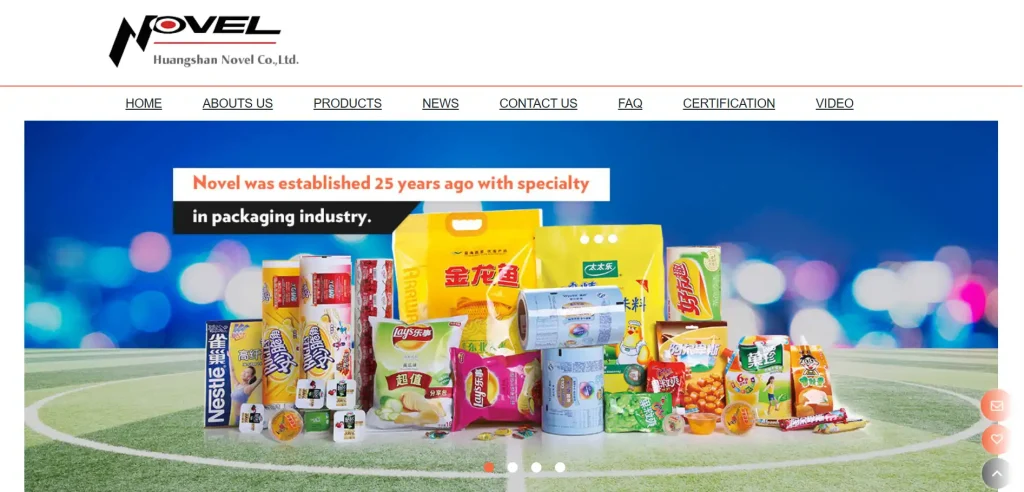
Advantage type: Packaging-materials group with vacuum metallizing as part of a broader manufacturing chain.
Evidence snapshot: The same exchange-hosted PDF describes Yongxin as producing and operating vacuum metallizing, multifunction films, printed laminated flexible packaging materials, and related packaging materials for food, daily chemicals, and pharma.
Why it matters to buyers:
- Many buyers prefer suppliers that understand metallized film not only as a roll-good, but as part of a packaging system (printing, lamination, end-use compliance).
Typical fit:
- Projects that value packaging-system capability and documented involvement in vacuum metallizing within the packaging material chain.
What to verify in RFQ:
- Whether you are buying raw metallized film rolls, converted structures, or a combination; confirm documentation flow (COA, traceability, compliance declarations).
9) Anhui Jintian High-Tech Material / Gettel (Gettel)
Official website: https://www.gettel.cn/
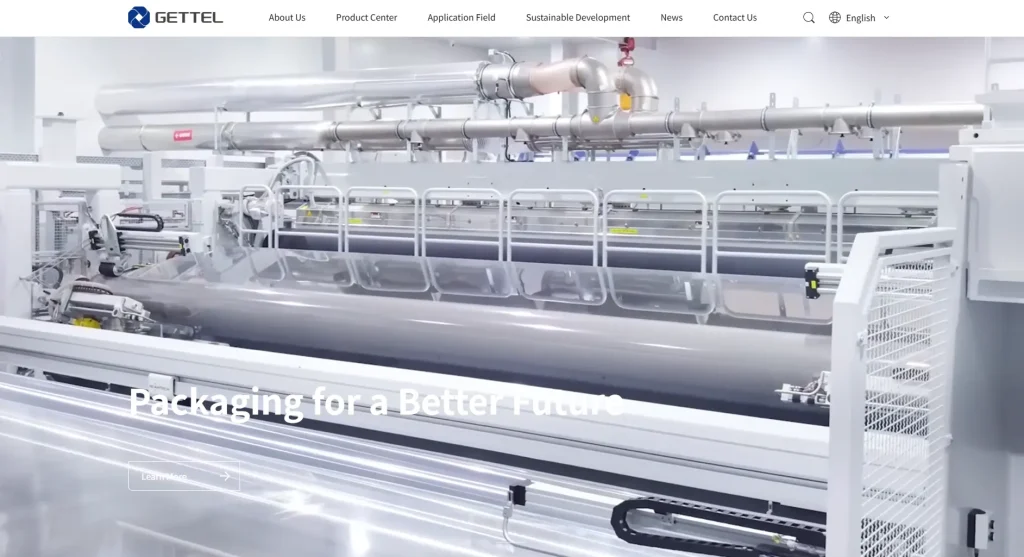
Advantage type: Clear metallized product positioning plus detailed “processing and compliance” claims on product pages, with a broader BOPP functional-film base.
Evidence snapshot: Gettel’s BOPP metallized film page states typical packaging applications (nuts, biscuits, puffed snacks, medicines, dehydrated foods), and lists product advantages including oxygen/moisture barrier and light shielding, printing/lamination adaptability, excellent aluminum adhesion, and claims compliance with international food-contact standards, plus customizable heat-seal features.
Additional identity anchor: A 36Kr project page describes Anhui Jintian as a BOPP film producer whose products include metallized base film among functional films.
Why it matters to buyers:
- Strong buyer-facing clarity: applications, advantages, and customization statements reduce RFQ friction.
Typical fit:
- Food and FMCG packaging structures needing metallized BOPP with stable converting behavior and a supplier used to functional film requirements.
What to verify in RFQ:
- Provide your destination-market compliance requirement (EU/US/etc.) and request the matching declarations and migration testing references.
- Confirm heat-seal window and aluminum adhesion under your adhesive and line conditions.
10) Tradsark New Materials (Weifang) Co., Ltd. (Tradsark)
Official website: https://www.tradsark.net/
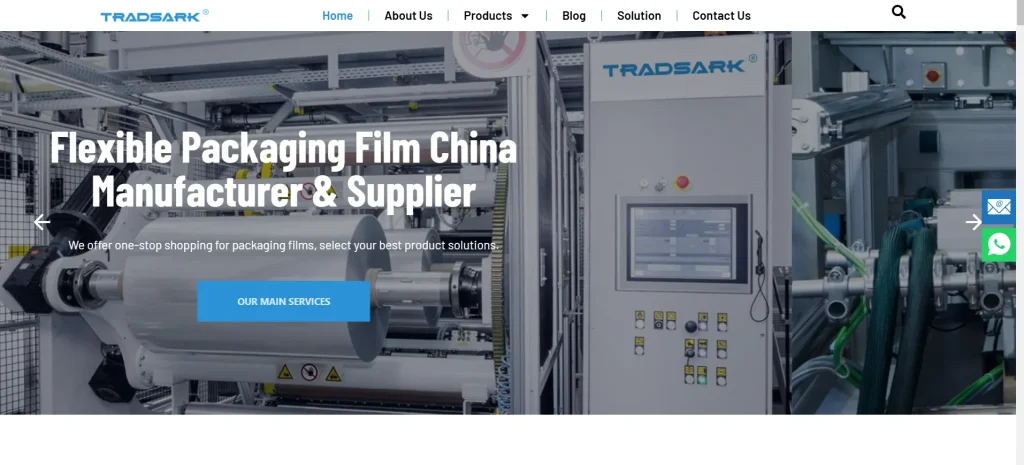
Advantage type: Export-oriented manufacturer emphasizing multiple film categories, with clear “Since 2016” positioning and production-line disclosure.
Evidence snapshot (company-stated): Tradsark’s ”About Us” page positions the company since 2016, states it is specialized in producing and exporting film products (including BOPP, BOPET, CPP, and metallized film), and discloses 12 fully automated production lines plus stated certifications and annual production capacity of 80,000 tons.
Why it matters to buyers:
- Many importers and distributors want consolidated sourcing: transparent packaging films + metallized films + functional reflective/insulation/agricultural films in fewer shipments. Tradsark’s positioning aligns with that procurement reality, as long as each SKU’s compliance and barrier targets are confirmed by documents and pilot rolls.
Typical fit:
- Buyers who need a broader film basket and prefer export-oriented communication and packaging documentation workflows.
What to verify in RFQ:
- For each destination market, confirm food-contact compliance documentation, barrier test conditions, and roll QA standards.
- Ask for recent production COA and trial roll recommendations for your line speed.
Verification Notice (Required Due Diligence)
The company-identity and registration details referenced in this article should be verified against the official database of the National Enterprise Credit Information Publicity System (GSXT), China, which is the authoritative source for corporate registration and public credit information. For due diligence consistency, readers should treat GSXT public records as of December 31, 2025 as the baseline reference and rely on the real-time query results shown in the system for final confirmation. Corporate registration data (e.g., legal entity name, business scope, legal representative, shareholding structure, and any abnormal-operation records) may change over time. This article is provided for informational purposes only and does not constitute legal, financial, or audit advice.
Official GSXT link: https://www.gsxt.gov.cn/
