
Introduction: Why Agricultural Reflective Mylar Film Matters
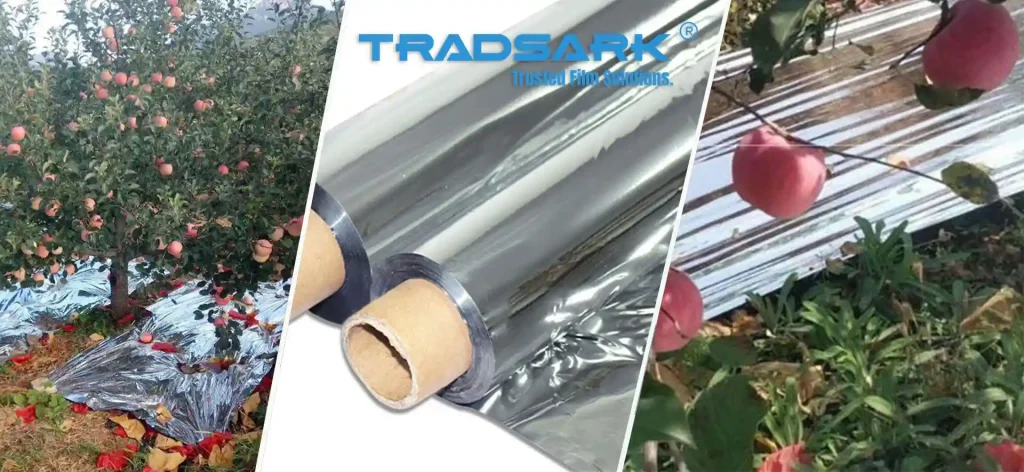
Agricultural reflective mylar film is revolutionizing modern horticulture and greenhouse farming. Reflective Mylar for plants is a lightweight, durable, and highly reflective material that can dramatically improve light distribution, photosynthesis efficiency, and crop quality. By redirecting sunlight back into the plant canopy, it addresses a common problem in dense orchards or shaded greenhouse areas: insufficient light at the lower canopy levels.
For crops like apples, strawberries, grapes, and high-value greenhouse vegetables, maximizing light exposure is directly linked to better fruit color, uniform ripening, and higher yield. Farmers in Shandong and Shaanxi, China, as well as Washington State, USA, have increasingly adopted aluminized reflective films to improve both the market value of their produce and overall productivity.
In this guide, we will explore the composition, benefits, technical specifications, applications, installation methods, maintenance tips, and real-world case studies for agricultural reflective mylar film, ensuring that readers have a practical, research-backed understanding of this technology.
1. What is Agricultural Reflective Mylar Film?
Agricultural reflective mylar film is a composite material designed to enhance light reflection in horticultural and greenhouse applications. The base material is typically polyethylene (PE), polypropylene (PP), or polyethylene terephthalate (PET). A highly reflective metallic layer, such as aluminum, titanium dioxide, or ceramic particles, is applied using vacuum metallization, lamination, or coating processes.
This film works by redirecting sunlight back into the plant canopy, ensuring that lower leaves and backlit fruits receive adequate light. The benefits include:
- Enhanced photosynthesis
- Improved fruit pigmentation
- Uniform ripening
- Increased blossom rates and fruit set
Reflective mylar is used in apple orchards, vineyards, strawberry plantations, citrus groves, and greenhouse crops. It can be applied between tree rows, under the canopy, or on greenhouse floors, depending on crop type and cultivation method.
Key point: Choosing the right thickness, reflectivity, and size is crucial to maximize efficiency.
2. Composition and Structure
2.1 Base Substrate
- Materials: PE, PP, PET
- Function: Provides mechanical strength, flexibility, and tear resistance
- Thickness: 15–30 µm (adjustable to crop type and environmental conditions)
2.2 Reflective Layer
- Materials: Aluminum, titanium dioxide, or ceramic particles
- Reflectivity: Up to 95% of visible and near-UV light
- Function: Maximizes light return to leaves and fruits, enhances fruit color and photosynthesis
2.3 Optional Coatings
- UV-stabilized coatings for long-term outdoor use
- Anti-scratch or corrosion-resistant coatings to improve durability
- Ensures the film lasts 1–3 growing seasons
3. Technical Specifications
| Parameter | Unit | Range / Typical Value | Notes |
|---|---|---|---|
| Film Thickness | µm | 15–30 | Customizable |
| Width | m | 1–2.5 | Can be cut for rows or greenhouse size |
| Length | m | 1,200–3,000 | Can be customized |
| Aluminum Layer Thickness | Å | 300–500 | Enhances reflectivity |
| Reflectivity | % | Up to 95 | Both sides metalized optional |
| Tear Strength | N | >120 MD / >100 TD | High tensile strength |
| UV Resistance | h | Up to 1,000 | Dependent on coating |
| Color | – | Silver / Black / White / Custom | Matching crop needs |
Tip: Always select thickness and width based on orchard spacing or greenhouse layout. Thicker films may provide higher durability, while thinner films are easier to handle and install.
4. Key Benefits of Reflective Mylar Film
4.1 Enhanced Fruit Color and Quality
Reflective films redirect UV and visible light back into the canopy, promoting uniform fruit pigmentation. Studies have shown:
- Apple orchards: 12–18% increase in red color intensity
- Vineyards: Improved grape sugar content and skin coloration
- Strawberry farms: Earlier ripening and larger berries
Practical tip: Place the aluminized side facing upward for maximum reflection.
4.2 Increased Photosynthesis and Leaf Density
By enhancing light exposure to lower leaves, reflective films improve photosynthesis efficiency, resulting in:
- Denser, healthier foliage
- Stronger plant structure
- Better nutrient absorption
This supports higher fruit loads and consistent fruit size.
4.3 Improved Blossom Rate and Fruit Set
Reflective light stimulates flower initiation, ensuring more consistent fruit set. For high-density orchards, this reduces variability in fruit size and quality.
4.4 Cost-Effectiveness and Energy Efficiency
In greenhouse settings, reflective mylar film can reduce the need for artificial lighting, decreasing energy costs. It also mitigates shading effects in high-density planting, reducing crop loss and uneven ripening.
4.5 Environmental and Practical Benefits
- Durable and reusable across multiple seasons
- Reduces the need for chemical treatments to enhance color
- Lightweight, flexible, and easy to cut or fold
5. Applications Across Crops
5.1 Apple Orchards
- Place reflective film between tree rows, aluminum side up
- Increases fruit color and sweetness
- Improves leaf density and photosynthetic efficiency
- Particularly effective in high-latitude regions with weaker sunlight
5.2 Strawberry Planting
- Use black PE film for soil beds (weed control)
- Apply reflective aluminum film under greenhouse benches to promote flowering
5.3 Vineyards and Citrus Orchards
- Reflective film improves light penetration, enhancing grape and citrus fruit quality
- Promotes even ripening and sugar accumulation
5.4 Greenhouse Crops
- Lay reflective film on floors or between crop rows
- Enhances natural light without additional energy input
- Compatible with hydroponics or soil-based planting systems
6. Installation Guidelines
6.1 Orchard Deployment
- Roll the reflective film along tree rows with aluminum side facing up
- Maintain slight tension to prevent sagging or wind damage
- Overlap ends by 5–10 cm for complete coverage
- Secure edges with stakes or clips
6.2 Greenhouse Application
- Lay film on the floor or between crop rows
- Use clips, adhesive spray, or tape to hold in place
- Replace or clean periodically to maintain high reflectivity
Tip: Avoid covering drip irrigation lines directly; leave small gaps to allow water penetration.
7. Maintenance Tips
- Inspect regularly for tears, punctures, or dirt accumulation
- Clean gently with mild water and soft cloth
- Store unused rolls in a cool, dry environment
- UV-stabilized films last 1–3 seasons, depending on weather conditions
8. Real-World Case Studies
Case 1: Apple Orchard, Shandong, China
- 2-hectare orchard installed aluminized reflective film between rows
- Results:
- Fruit red color increased 15%
- Average fruit size increased 12%
- Harvest yield increased 18% compared to control
Case 2: Vineyard, California, USA
- 1-hectare high-density grape planting
- Reflective mylar under vine canopy
- Results:
- Brix sugar content increased 1.5–2 units
- Uniform ripening reduced sorting labor by 20%
Case 3: Strawberry Greenhouse, Netherlands
- Black PE for soil, reflective aluminum for canopy reflection
- Results:
- Early flowering advanced 7–10 days
- Larger, more uniform berries
- Reduced supplemental lighting by 25%, saving electricity
Tip for farmers: Always document results with before-and-after photos and yield metrics to evaluate ROI.
9. Frequently Asked Questions (FAQ)
Q1: Is reflective mylar film safe for edible crops?
A: Yes, PE/PET substrates with aluminum coatings are non-toxic and safe for agriculture.
Q2: How long does the reflective property last?
A: With proper installation and UV-stabilized coatings, efficiency lasts 1–3 growing seasons.
Q3: Can the film be reused?
A: Yes, durable substrates allow multiple uses across seasons.
Q4: Can the film be customized?
A: Absolutely, thickness, width, length, and reflectivity can be tailored.
Q5: Does the film reduce the need for artificial lighting?
A: Yes, particularly in greenhouse environments, it enhances natural light distribution and reduces supplemental lighting costs.
10. Economic and Environmental Impact
- Cost-effective: Reduces labor and energy costs for fruit color enhancement
- Environmentally friendly: Reusable, reduces chemical treatments
- High ROI: Boosts yield and quality, increasing marketable revenue
- Energy-saving: Lowers greenhouse lighting requirements by 20–30%
11. Customization Options
| Customization | Options |
|---|---|
| Thickness | 15, 16, 18, 20, 25, 30 µm |
| Width | 1, 1.2, 1.5, 2, 2.3, 2.5 m |
| Length | 1,200 m, 2,000 m, 3,000 m, custom |
| Reflective Coating | Aluminum, titanium dioxide, ceramic |
| Color | Silver, Black, White, Custom |
| Surface | Smooth, anti-scratch, UV-stabilized |
Pro tip: Adjust thickness based on orchard row spacing and expected weather conditions for maximum durability.
12. Additional Tips for Maximum Efficiency
- Use reflective side up consistently
- Combine with drip irrigation and mulch for improved water efficiency
- Regularly clean the film to maintain 95% reflectivity
- Monitor plant response and adjust placement for optimal light coverage
Conclusion
Agricultural reflective mylar film is an essential tool for modern horticulture. By improving light distribution within plant canopies, it enhances fruit color, leaf density, blossom rates, and overall yield. Its lightweight, durable, and customizable nature makes it ideal for apple orchards, strawberry farms, vineyards, citrus groves, and greenhouse crops.
Using reflective mylar film allows farmers to:
- Increase productivity and marketable yield
- Improve energy efficiency in greenhouses
- Reduce reliance on chemical treatments
- Achieve uniform, high-quality fruits
Implementing reflective mylar technology is a cost-effective, environmentally friendly strategy that transforms natural sunlight into a higher-value harvest.
